Should You Take a Bath in Your Jeans and Other Common Denim Questions
Denim Lore with Kiya Babzani, Part II
Yesterday, we talked with Kiya Babzani - co-owner and founder of Self Edge - about whether or not people should really wait six months before washing their jeans. Today, we’ll explore three other common beliefs in the denim community, including the one about taking a bath in your jeans when you first bring them home. 
Derek Guy: It’s commonly advised that jeans should always fit extremely tight when you first buy them – to the point where you can barely button them up. Is that true?
Kiya Babzani: Definitely not. There are two deciding factors when buying jeans: does it look good and does it feel good? If you’re stuffing yourself into a pair of jeans two sizes too small because that’s what the blogs and message boards tell you, you’re doing it wrong.
DG: Isn’t the idea that some jeans will heavily stretch over time?
KB: If you’re a 32 and you buy a pair of jeans in a size 30 to account for stretching, you’re going to look like a stuffed sausage and have red slashes at your hips for weeks. That’s neither comfortable nor attractive. Also, most decent jeans don’t stretch that much with wear. The maximum is about 1.5” or so unless you get them extremely tight when new.
DG: How about the idea that you should first wear your jeans in the bathtub while letting them soak?
KB: People like to overcomplicate the wearing of jeans. The idea that you should wear your jeans in a bathtub is a terrible idea. It’s not only uncomfortable, but it stretches out the jeans in unnatural ways. It creates knee-bagging and pulls at the hips, giving you hip-flare.
It’s true, however, that you should always soak unsanforized denim before wearing (you don’t need to for sanforized denim). If you’re buying them from a store, you should find the fit you like then buy one size up and do a 30-minute hot water soak once you bring them home. If you’re buying online, just buy one size/measurement up from your true size.
You need to soak unsanforized denim so that the shrinkage is gone before you start the fading process. The jeans will also last far longer if soaked before wearing. You don’t need to do it while wearing them in the tub, however. Again, this will just create unnatural stretching in areas such as the knees and hips. Just throw them in a tub, sink, or bucket, and let them soak. 
DG: OK, let’s do one last bit of denim lore. I’ve read that raw denim will mold to your body. Is this actually true?
KB: Yes, all raw denim will mold to your body, but sanforized denim only slightly molds, while unsanforized denim will take on the shape of your figure. If you take two pairs of jeans in the same fit and size, one sanforized and one unsanforized, soak them both in water for five minutes, put them on, and let them dry (not something I recommend doing, by the way, for the reasons mentioned above). This will quicken the process of “molding.” Afterwards, you can take the jeans off and lay them down. You’ll then notice that the sanforized pair will be nearly like they were before, while the unsanforized pair will look like you’re still wearing them.
DG: Thanks for taking the time to speak with us, Kiya
KB: Thank you.
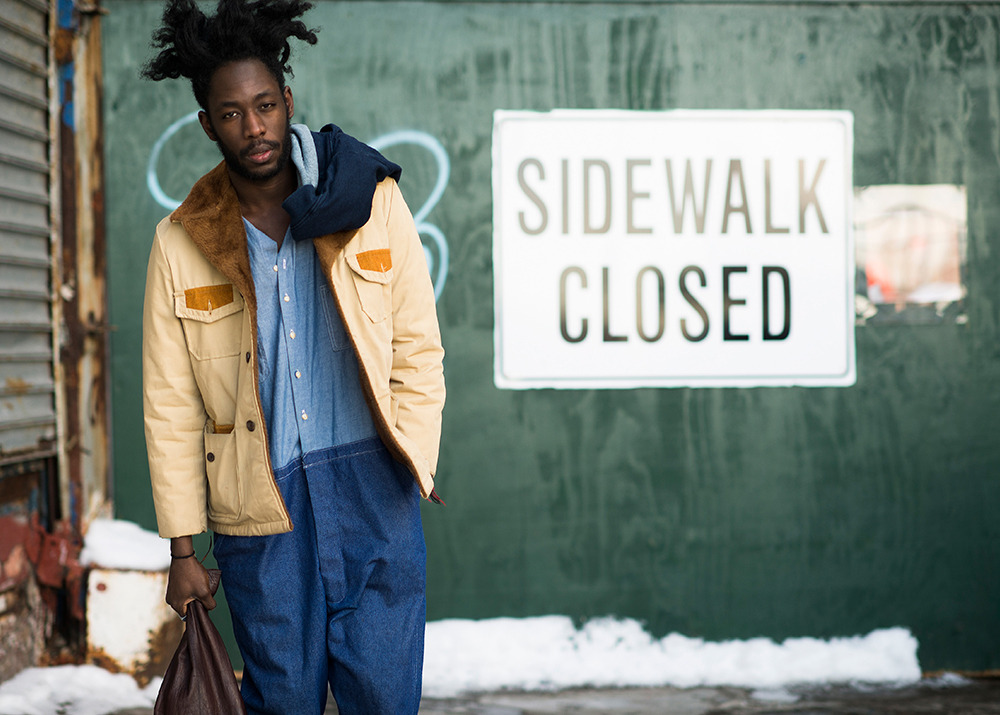
(Photo credit: Farhad Samari)

Should You Take a Bath in Your Jeans and Other Common Denim Questions

Denim Lore with Kiya Babzani, Part II

Yesterday, we talked with Kiya Babzani - co-owner and founder of Self Edge - about whether or not people should really wait six months before washing their jeans. Today, we’ll explore three other common beliefs in the denim community, including the one about taking a bath in your jeans when you first bring them home. 

Derek Guy: It’s commonly advised that jeans should always fit extremely tight when you first buy them – to the point where you can barely button them up. Is that true?

Kiya Babzani: Definitely not. There are two deciding factors when buying jeans: does it look good and does it feel good? If you’re stuffing yourself into a pair of jeans two sizes too small because that’s what the blogs and message boards tell you, you’re doing it wrong.

DG: Isn’t the idea that some jeans will heavily stretch over time?

KB: If you’re a 32 and you buy a pair of jeans in a size 30 to account for stretching, you’re going to look like a stuffed sausage and have red slashes at your hips for weeks. That’s neither comfortable nor attractive. Also, most decent jeans don’t stretch that much with wear. The maximum is about 1.5” or so unless you get them extremely tight when new.

DG: How about the idea that you should first wear your jeans in the bathtub while letting them soak?

KB: People like to overcomplicate the wearing of jeans. The idea that you should wear your jeans in a bathtub is a terrible idea. It’s not only uncomfortable, but it stretches out the jeans in unnatural ways. It creates knee-bagging and pulls at the hips, giving you hip-flare.

It’s true, however, that you should always soak unsanforized denim before wearing (you don’t need to for sanforized denim). If you’re buying them from a store, you should find the fit you like then buy one size up and do a 30-minute hot water soak once you bring them home. If you’re buying online, just buy one size/measurement up from your true size.

You need to soak unsanforized denim so that the shrinkage is gone before you start the fading process. The jeans will also last far longer if soaked before wearing. You don’t need to do it while wearing them in the tub, however. Again, this will just create unnatural stretching in areas such as the knees and hips. Just throw them in a tub, sink, or bucket, and let them soak. 

DG: OK, let’s do one last bit of denim lore. I’ve read that raw denim will mold to your body. Is this actually true?

KB: Yes, all raw denim will mold to your body, but sanforized denim only slightly molds, while unsanforized denim will take on the shape of your figure. If you take two pairs of jeans in the same fit and size, one sanforized and one unsanforized, soak them both in water for five minutes, put them on, and let them dry (not something I recommend doing, by the way, for the reasons mentioned above). This will quicken the process of “molding.” Afterwards, you can take the jeans off and lay them down. You’ll then notice that the sanforized pair will be nearly like they were before, while the unsanforized pair will look like you’re still wearing them.

DG: Thanks for taking the time to speak with us, Kiya

KB: Thank you.

(Photo credit: Farhad Samari)

Should I Really Wait Six Months To Wash My Jeans?
Denim Lore with Kiya Bazani, Part One
Jesse’s excerpt from Marc Maron’s hilarious NYT article yesterday coincidentally comes just a day before I finished my interview with Kiya Babzani. As Marc’s article alludes to, there are some seemingly strange beliefs today on how to get the perfect pair of jeans: wear them in the bathtub when you first get them home, don’t wash them for six months, stick them in the oven (!) or freezer if they start to stink, run around in the ocean with them on, etc. 
I asked Kiya if he could talk with us to see if some of these things are true. Kiya is the co-owner and founder of Self Edge, a very popular shop for jeans with locations in Los Angeles, San Francisco, and New York. On menswear forums, he’s commonly considered an expert on denim, so I thought he’d be a great person to talk to about denim lore. 
Derek Guy: Let’s start with the most popular piece of advice: that one should not wash their jeans for at least the first six months of them being worn. Is this true?
Kiya Babzani: To my knowledge, that’s something that was started by APC and/or Nudies. There are a couple of reasons why someone would recommend that you shouldn’t wash your jeans. First, people getting into raw selvedge denim are usually looking for a certain type of look – one that has high contrast fades with dramatically defined lines around the top of the lap and behind the knees. This kind of fading is difficult to achieve with denim that has been done to death, which is what most brands use.
DG: Can you explain what do you mean by “done to death?”
KB: I mean fabric that has been singed, mercerized, calendered, and sanforized. They’ve taken every bit of life out of the fabric, leaving something very smooth and even. With denim treated like this – yes, you’ll normally need infrequent washings to get a very high-contrast fade at the end. But what most people don’t talk about is how if you buy a pair of jeans made from unsanforized denim, you’ll get these kinds of fades even if you washed your jeans every two weeks.  
With unsanforized loomstate denim, the fabric is rigid and creases set in far faster. Additionally, due to the micro-hairs on the fabric (which are sometimes visible), the denim is more abrasive, which will allow you to get that very defined, high contrast look naturally, even with frequent washings.
DG: So denim that has been heavily treated – singed, mercerized, sanforized, etc. – will need longer periods of not being washed in order to get those high contrast fades, but unsanforized loomstate denim can achieve that with regular washings (every two weeks or so)?
KB: Yes, but add to this the fact that washing your jeans regularly is the sanitary thing to do, and doing so will make your jeans last longer. Cotton fibers become brittle with time and they need to be routinely “moisturized” (for lack of a better word). The longer you go without washing, the more prone your jeans are to crotch blowouts and “punch holes” behind the knees.
In the end, however, you never get fades on sanforized denim that are as interesting as you would on unsanforized denim. Of course, this is all very subjective, but in my opinion, unsanforized denim will always develop a more beautiful and interesting look.
DG: What about denim that has just been sanforized, but nothing else?
KB: Sanforization is the leading cause of what I explained above, with everything else being a minor addition.
[Check back tomorrow for part two of our interview with Kiya]
(Photo credit: Farhad Samari)

Should I Really Wait Six Months To Wash My Jeans?

Denim Lore with Kiya Bazani, Part One

Jesse’s excerpt from Marc Maron’s hilarious NYT article yesterday coincidentally comes just a day before I finished my interview with Kiya Babzani. As Marc’s article alludes to, there are some seemingly strange beliefs today on how to get the perfect pair of jeans: wear them in the bathtub when you first get them home, don’t wash them for six months, stick them in the oven (!) or freezer if they start to stink, run around in the ocean with them on, etc. 

I asked Kiya if he could talk with us to see if some of these things are true. Kiya is the co-owner and founder of Self Edge, a very popular shop for jeans with locations in Los Angeles, San Francisco, and New York. On menswear forums, he’s commonly considered an expert on denim, so I thought he’d be a great person to talk to about denim lore. 

Derek Guy: Let’s start with the most popular piece of advice: that one should not wash their jeans for at least the first six months of them being worn. Is this true?

Kiya Babzani: To my knowledge, that’s something that was started by APC and/or Nudies. There are a couple of reasons why someone would recommend that you shouldn’t wash your jeans. First, people getting into raw selvedge denim are usually looking for a certain type of look – one that has high contrast fades with dramatically defined lines around the top of the lap and behind the knees. This kind of fading is difficult to achieve with denim that has been done to death, which is what most brands use.

DG: Can you explain what do you mean by “done to death?”

KB: I mean fabric that has been singed, mercerized, calendered, and sanforized. They’ve taken every bit of life out of the fabric, leaving something very smooth and even. With denim treated like this – yes, you’ll normally need infrequent washings to get a very high-contrast fade at the end. But what most people don’t talk about is how if you buy a pair of jeans made from unsanforized denim, you’ll get these kinds of fades even if you washed your jeans every two weeks.  

With unsanforized loomstate denim, the fabric is rigid and creases set in far faster. Additionally, due to the micro-hairs on the fabric (which are sometimes visible), the denim is more abrasive, which will allow you to get that very defined, high contrast look naturally, even with frequent washings.

DG: So denim that has been heavily treated – singed, mercerized, sanforized, etc. – will need longer periods of not being washed in order to get those high contrast fades, but unsanforized loomstate denim can achieve that with regular washings (every two weeks or so)?

KB: Yes, but add to this the fact that washing your jeans regularly is the sanitary thing to do, and doing so will make your jeans last longer. Cotton fibers become brittle with time and they need to be routinely “moisturized” (for lack of a better word). The longer you go without washing, the more prone your jeans are to crotch blowouts and “punch holes” behind the knees.

In the end, however, you never get fades on sanforized denim that are as interesting as you would on unsanforized denim. Of course, this is all very subjective, but in my opinion, unsanforized denim will always develop a more beautiful and interesting look.

DG: What about denim that has just been sanforized, but nothing else?

KB: Sanforization is the leading cause of what I explained above, with everything else being a minor addition.

[Check back tomorrow for part two of our interview with Kiya]

(Photo credit: Farhad Samari)

DIY: Denim Jacket
Trent over at Survival of the Fittist posted about this denim jacket a few days ago. And while it’s a nice jacket, what makes it even more impressive is that he constructed the jacket himself from a thrifted pair of selvedge denim jeans:
I’m really glad I undertook this mission. First, I don’t know how many people can say they’ve made a pair of pants into a jacket. Second, it helped boost my confidence to undertake more sewing projects that aren’t strictly alterations.
Granted, not everyone can go out and make their own denim jacket and Trent’s been altering his own clothing for quite a while — see his Meatball Tailoring posts — but it’s really refreshing to see people creating clothing on their own for their own enjoyment. Given how much time and copy is spent talking about things you can buy, I think it’s something really special when you see a do-it-yourself project like this.  
-Kiyoshi

DIY: Denim Jacket

Trent over at Survival of the Fittist posted about this denim jacket a few days ago. And while it’s a nice jacket, what makes it even more impressive is that he constructed the jacket himself from a thrifted pair of selvedge denim jeans:

I’m really glad I undertook this mission. First, I don’t know how many people can say they’ve made a pair of pants into a jacket. Second, it helped boost my confidence to undertake more sewing projects that aren’t strictly alterations.

Granted, not everyone can go out and make their own denim jacket and Trent’s been altering his own clothing for quite a while — see his Meatball Tailoring posts — but it’s really refreshing to see people creating clothing on their own for their own enjoyment. Given how much time and copy is spent talking about things you can buy, I think it’s something really special when you see a do-it-yourself project like this.  

-Kiyoshi

Kickstarter of Interest: Gustin denim
Last week a Kickstarter project came to our attention from the team at Gustin, who is offering their denim at wholesale prices direct to pre-sale customers instead of selling to retailers. The project met its fundraising goal on the first day. 
If you back the project for $81, then you can receive a pair of selvedge denim jeans made in San Francisco from fabric from White Oak Cone Mills. Compared to several other made-in-the-U.S.A. raw denim brands at retail, that’s under half what you’d typically see.
Personally, none of us here have had hands-on experience with Gustin denim, so we can’t fully comment on things such as fit and construction. There is a sizing chart here, which you can use to compare to other pairs of jeans you may own. For some insight from people who have tried on a pair, Gus at A Bit of Color had some thoughts as does Mark at Simpler Man.
I also wondered about the possibilities of returns or exchanges for Gustin’s Kickstarter backers. Here’s the response I received from Stephen at Gustin:


We’re not going to officially allow returns or exchanges (Kickstarter makes it quite difficult), but we’ll do our best to facilitate swapping of sizes if there’s an issue. After Kickstarter - absolutely. The goal is to have free shipping both ways. It’ll work like Zappos - you can order 3 styles in 3 sizes, and just keep what fits.


I personally think the idea of crowd-funding is an interesting approach to addressing the cost issue of raw denim (and apparently so do more than 800 other people backing the project). I’d just caution looking over the size chart carefully and making sure the fit works for your needs. 
-Kiyoshi

Kickstarter of Interest: Gustin denim

Last week a Kickstarter project came to our attention from the team at Gustin, who is offering their denim at wholesale prices direct to pre-sale customers instead of selling to retailers. The project met its fundraising goal on the first day. 

If you back the project for $81, then you can receive a pair of selvedge denim jeans made in San Francisco from fabric from White Oak Cone Mills. Compared to several other made-in-the-U.S.A. raw denim brands at retail, that’s under half what you’d typically see.

Personally, none of us here have had hands-on experience with Gustin denim, so we can’t fully comment on things such as fit and construction. There is a sizing chart here, which you can use to compare to other pairs of jeans you may own. For some insight from people who have tried on a pair, Gus at A Bit of Color had some thoughts as does Mark at Simpler Man.

I also wondered about the possibilities of returns or exchanges for Gustin’s Kickstarter backers. Here’s the response I received from Stephen at Gustin:

We’re not going to officially allow returns or exchanges (Kickstarter makes it quite difficult), but we’ll do our best to facilitate swapping of sizes if there’s an issue. After Kickstarter - absolutely. The goal is to have free shipping both ways. It’ll work like Zappos - you can order 3 styles in 3 sizes, and just keep what fits.

I personally think the idea of crowd-funding is an interesting approach to addressing the cost issue of raw denim (and apparently so do more than 800 other people backing the project). I’d just caution looking over the size chart carefully and making sure the fit works for your needs. 

-Kiyoshi

It’s On Sale: Gap selvedge denim
If you’ve been looking for affordable selvedge denim, then Gap would be worth a look right now. Use code 24HOURS to receive 30% off your entire order at Gap, which includes their 1969 line of selvedge rigid denim in skinny, slim, straight and original fits. This brings the price down to $63 a pair.
It’s also worth noting the same coupon code works at Banana Republic and Old Navy. Deal expires at midnight tonight.
-Kiyoshi

It’s On Sale: Gap selvedge denim

If you’ve been looking for affordable selvedge denim, then Gap would be worth a look right now. Use code 24HOURS to receive 30% off your entire order at Gap, which includes their 1969 line of selvedge rigid denim in skinny, slim, straight and original fits. This brings the price down to $63 a pair.

It’s also worth noting the same coupon code works at Banana Republic and Old Navy. Deal expires at midnight tonight.

-Kiyoshi

The Centraal Museum in Utrecht, Netherlands just opened a fascinating-looking exhibit on the history of blue jeans. It traces their history from the 1600s, when we have the first evidence of denim, to today. I wish I were in Europe so I could check it out! You can check out some beautiful photos of the exhibition and read about the history of jeans here.

The Silentist on the value of plain old Levi’s 501s.
If you happen to live in the Bay Area, check out this three-day series of events on all things denim. The second day even has stuff by Rising Sun, who we featured in our very first episode (which was on denim, if you didn’t already know). 

If you happen to live in the Bay Area, check out this three-day series of events on all things denim. The second day even has stuff by Rising Sun, who we featured in our very first episode (which was on denim, if you didn’t already know). 

(Source: abitofcolor)

jackknifeoutfitters:

Jack/Knife Japanese Grey Cast Selvedge Denim.

Our friend Gus of the excellent tumblog abitofcolor tells us he just paid a visit to the atelier of Jack/Knife Outfitters, a new bespoke denim service in San Francisco. They offer full bespoke service - they create a pattern just for you - and a range of American and Japanese denim. Gus is a sharp tack, and he was impressed enough to decide to order a pair.
There are a variety of folks out there offering services like this, but most are made-to-measure (meaning they adjust pre-made patterns), and most cost much more than Jack/Knife. According to Gus, depending on the fabric, prices range from $200 to $400. Still a pretty penny, but a very fair price for bespoke pants of any kind.

jackknifeoutfitters:

Jack/Knife Japanese Grey Cast Selvedge Denim.

Our friend Gus of the excellent tumblog abitofcolor tells us he just paid a visit to the atelier of Jack/Knife Outfitters, a new bespoke denim service in San Francisco. They offer full bespoke service - they create a pattern just for you - and a range of American and Japanese denim. Gus is a sharp tack, and he was impressed enough to decide to order a pair.

There are a variety of folks out there offering services like this, but most are made-to-measure (meaning they adjust pre-made patterns), and most cost much more than Jack/Knife. According to Gus, depending on the fabric, prices range from $200 to $400. Still a pretty penny, but a very fair price for bespoke pants of any kind.