Q & Answer: How Do I Eliminate the Blousing on a Shirt?
Gary writes: I just got a new job and am having to wear dress shirts for the first time. I went out this weekend and tried a bunch on, but all of them seem to blouse and billow over the top of my pants. Is there any way to fix this, or do I just have to keep searching for the perfect shirt?
Ready-to-wear clothing rarely fits perfectly off the rack. Remember, garments are made with an imaginary person in mind, usually someone that’s an “average” of the demographic the company is trying to target. You’re unlikely to be that exact average, so some alterations will likely be necessary.
The less you alter a garment, however, the better. So the first step is to find a shirt that fits as well as possible. After you find one and purchase it, take it to the tailors to have the sides slimmed down. This will take out most of the billowing, but be sure to not go too slim. You want to be able to sit down and have a full meal, after all.
If you’d like, you can also have darts put in. These will help reduce the fullness in the lower back. They’re good for most men, but if you stand with a bit of a hunch, note that they’ll accentuate your less than ideal posture (as they’ll create a bit of an S curve from your side profile). You can get them put into one shirt and see how you like the effect. They can be taken out afterwards if you don’t like them, but on many cotton shirts, this will leave some faint lines where the darts used to be. The job of taking in the sides and putting in darts should probably run you something like $15.
If you find that you still have some blousing even after alterations, you can try the military tuck. That’s when you tuck your shirt in straight, but then pinch the sides and pull them back to reduce fullness. You can see a simple guide on how to do it here.
A good alterations tailor and military tuck will solve most of the billowing, but if you’re striving for perfection, you’ll likely need to go custom. I’ve written a seven-part series on custom shirts, which you can read here.
This is one area where I find bespoke makers to be a bit better than most made-to-measure services. With a good bespoke tailor, you’re getting a custom pattern drafted from scratch. With made-to-measure, the company is usually altering an existing pattern through some computer program. The first, from my experience, allows you to more easily account things that might not be easily captured by simple measurements. For example, my tailor (Ascot Chang) lowered the waist point on my first pattern, so that narrowest part of the shirt aligned with the narrowest point of my torso. This allowed the shirt to better transition as it moved down to my hips, thus distributing the fullness perfectly when my shirt is tucked (like this). That kind of adjustment is often not possible through made-to-measure, and isn’t something an alterations tailor can do for you. 
Bespoke shirts are expensive, however. If you don’t mind the cost, I think they’re worth it. For most men though, a $15 alterations job and military tuck will deliver most of what they need. 
(Photo via GQ)

Q & Answer: How Do I Eliminate the Blousing on a Shirt?

Gary writes: I just got a new job and am having to wear dress shirts for the first time. I went out this weekend and tried a bunch on, but all of them seem to blouse and billow over the top of my pants. Is there any way to fix this, or do I just have to keep searching for the perfect shirt?

Ready-to-wear clothing rarely fits perfectly off the rack. Remember, garments are made with an imaginary person in mind, usually someone that’s an “average” of the demographic the company is trying to target. You’re unlikely to be that exact average, so some alterations will likely be necessary.

The less you alter a garment, however, the better. So the first step is to find a shirt that fits as well as possible. After you find one and purchase it, take it to the tailors to have the sides slimmed down. This will take out most of the billowing, but be sure to not go too slim. You want to be able to sit down and have a full meal, after all.

If you’d like, you can also have darts put in. These will help reduce the fullness in the lower back. They’re good for most men, but if you stand with a bit of a hunch, note that they’ll accentuate your less than ideal posture (as they’ll create a bit of an S curve from your side profile). You can get them put into one shirt and see how you like the effect. They can be taken out afterwards if you don’t like them, but on many cotton shirts, this will leave some faint lines where the darts used to be. The job of taking in the sides and putting in darts should probably run you something like $15.

If you find that you still have some blousing even after alterations, you can try the military tuck. That’s when you tuck your shirt in straight, but then pinch the sides and pull them back to reduce fullness. You can see a simple guide on how to do it here.

A good alterations tailor and military tuck will solve most of the billowing, but if you’re striving for perfection, you’ll likely need to go custom. I’ve written a seven-part series on custom shirts, which you can read here.

This is one area where I find bespoke makers to be a bit better than most made-to-measure services. With a good bespoke tailor, you’re getting a custom pattern drafted from scratch. With made-to-measure, the company is usually altering an existing pattern through some computer program. The first, from my experience, allows you to more easily account things that might not be easily captured by simple measurements. For example, my tailor (Ascot Chang) lowered the waist point on my first pattern, so that narrowest part of the shirt aligned with the narrowest point of my torso. This allowed the shirt to better transition as it moved down to my hips, thus distributing the fullness perfectly when my shirt is tucked (like this). That kind of adjustment is often not possible through made-to-measure, and isn’t something an alterations tailor can do for you. 

Bespoke shirts are expensive, however. If you don’t mind the cost, I think they’re worth it. For most men though, a $15 alterations job and military tuck will deliver most of what they need. 

(Photo via GQ)

Q & Answer: My Arms Are Long. Where Can I Buy Clothes?
Abe asks: My question to you is how to shop if you have long arms? 
 In my case, I am 6’3” and my arm length is almost 40 inches. Given that tall/long clothing usually has 37 inch arms, what can I guy like me do in terms of off the rack clothing? Surely I am not the only one with this problem!
We get questions like this all the time from readers with extraordinary physical proportions. (I’m 6’3”, with longish arms, and they’re four inches shorter than Abe’s.) The truth is that you’ll simply have to go custom.
There are many retailers which offer tall sizes - online, I’d say you can check out LL Bean, Lands’ End, Banana Republic and J. Crew, for starters. That’ll work if you’re just a little taller than average. But if you’re way taller than average, or have much longer legs, or much longer arms, or a very, very small neck, or some other physical proportion that makes you Very Special… off the rack isn’t going to work for you.
The good news, though, is that we live in a golden age of custom clothes. It can sometimes take a few tries to get the fit right without an in-person consultation (and if you can afford it, I’d recommend a local, in-person maker), but if you can’t buy off the rack, it’s absolutely worth it. Derek wrote a series about custom shirts, and you can start there.

Q & Answer: My Arms Are Long. Where Can I Buy Clothes?

Abe asks: My question to you is how to shop if you have long arms?

 In my case, I am 6’3” and my arm length is almost 40 inches. Given that tall/long clothing usually has 37 inch arms, what can I guy like me do in terms of off the rack clothing? Surely I am not the only one with this problem!

We get questions like this all the time from readers with extraordinary physical proportions. (I’m 6’3”, with longish arms, and they’re four inches shorter than Abe’s.) The truth is that you’ll simply have to go custom.

There are many retailers which offer tall sizes - online, I’d say you can check out LL Bean, Lands’ End, Banana Republic and J. Crew, for starters. That’ll work if you’re just a little taller than average. But if you’re way taller than average, or have much longer legs, or much longer arms, or a very, very small neck, or some other physical proportion that makes you Very Special… off the rack isn’t going to work for you.

The good news, though, is that we live in a golden age of custom clothes. It can sometimes take a few tries to get the fit right without an in-person consultation (and if you can afford it, I’d recommend a local, in-person maker), but if you can’t buy off the rack, it’s absolutely worth it. Derek wrote a series about custom shirts, and you can start there.

Q & Answer: My Pocket Square Makes My Lapel Bulge!
Gus asks: I have a recurring problem with my jackets: the left lapel bulges open when I put a pocket square in the breast pocket.  Do you know of the cause of this and the cure?
The answer’s about as simple as you’d think it would be. Either your pocket square’s too big or your coat’s too small. With our squares, we usually cut at 16” square, though we go down a bit smaller for heavier fabric to prevent this problem. You can try a less scrunchy, more foldy pocket square arrangement - that might cut down on volume.
More likely though is that your coat is fitting tightly, either in the chest or at the buttoning point. So either have it let out a bit or hit the gym. The fad for tight-fitting jackets has led to a lot of gaping and bowing in our nation’s lapels, and jamming a pocket square in there can exacerbate the problem.

Q & Answer: My Pocket Square Makes My Lapel Bulge!

Gus asks: I have a recurring problem with my jackets: the left lapel bulges open when I put a pocket square in the breast pocket.  Do you know of the cause of this and the cure?

The answer’s about as simple as you’d think it would be. Either your pocket square’s too big or your coat’s too small. With our squares, we usually cut at 16” square, though we go down a bit smaller for heavier fabric to prevent this problem. You can try a less scrunchy, more foldy pocket square arrangement - that might cut down on volume.

More likely though is that your coat is fitting tightly, either in the chest or at the buttoning point. So either have it let out a bit or hit the gym. The fad for tight-fitting jackets has led to a lot of gaping and bowing in our nation’s lapels, and jamming a pocket square in there can exacerbate the problem.

These days, our friend PG from MostExerent works for a tech company that frowns on suits. His blog’s now mostly a record of his cycling and travel. There’s no better expert on the shape of tailored clothes, though, and his advice here is very much worth paying attention to.
mostexerent:

Another gem from my archives (2011) which will answer some recent messages & this time uncovered by linenforsummertweedforwinter:
Shape, Drape or Both?
Both is possible & preferable in my opinion - too many are trapped into thinking that tight fitting means shape.. When it is actually the opposite.
See how my jacket still has shape even not button up.
How is this possible?
Start with the shoulders then working down to the cuff:
Make sure they sit on with a slight extension & not before the shoulder point
“Natural” shaped shoulder line gives a softer & more sensual appearance whilst a structured shoulder will add power as well as elegance - nothing wrong with either as long as they suit your body type & not over built.
The chest needs enough fullness & not tightness - see the clean subtle draping. No creases or gaping. Everything looks ”natural”
The waist has ”natural” suppression at the ”natural” waist point to give shape - not tight like a corset
Hips are in line with the shoulder or below to give balance
Pants are sitting at your ”natural” waist not hips
Open quarters aka the bottom of the jacket where the left & right meet (noticeable when buttoned) will mirror the lapels in a figure eight
Skirt of the jacket has a slight flare
Pantaloons are hanging naturally & with a slight break.
So as it starts to warm up, ”airforce blue” is always a great option to wearing navy or grey. Especially if there is some mohair in the mix. This suit is totally different in direct light, it’s like DISCO! So one has to ensure the other components are subtle.
You want to make sure the over all effect does not compete but look ”natural”.
The oncoming eye should not be competing for any detail..
So DITCH the H belt or novelty cuff links..
Details | Suit - P Johnson in Loro Piana wool/mohair for GW | Shirt - P Johnson in Thomas Mason for GW | Knit tie - Drakes (this one is a mix of black & navy) | PS - vintage Japanese kimono cloth | DubMunks - John Lobb 2010 St Crepin for Leather Soul for GW
* My Sistah just enjoys PHOTO BOMBING!
** FYI - I am standing 3m away from the camera whilst my Sistah is 1.5m
Cut your coat according to your cloth.

These days, our friend PG from MostExerent works for a tech company that frowns on suits. His blog’s now mostly a record of his cycling and travel. There’s no better expert on the shape of tailored clothes, though, and his advice here is very much worth paying attention to.

mostexerent:

Another gem from my archives (2011) which will answer some recent messages & this time uncovered by linenforsummertweedforwinter:

Shape, Drape or Both?

Both is possible & preferable in my opinion - too many are trapped into thinking that tight fitting means shape.. When it is actually the opposite.

See how my jacket still has shape even not button up.

How is this possible?

Start with the shoulders then working down to the cuff:

  • Make sure they sit on with a slight extension & not before the shoulder point
  • “Natural” shaped shoulder line gives a softer & more sensual appearance whilst a structured shoulder will add power as well as elegance - nothing wrong with either as long as they suit your body type & not over built.
  • The chest needs enough fullness & not tightness - see the clean subtle draping. No creases or gaping. Everything looks ”natural”
  • The waist has ”natural” suppression at the ”natural” waist point to give shape - not tight like a corset
  • Hips are in line with the shoulder or below to give balance
  • Pants are sitting at your ”natural” waist not hips
  • Open quarters aka the bottom of the jacket where the left & right meet (noticeable when buttoned) will mirror the lapels in a figure eight
  • Skirt of the jacket has a slight flare
  • Pantaloons are hanging naturally & with a slight break.

So as it starts to warm up, ”airforce blue” is always a great option to wearing navy or grey. Especially if there is some mohair in the mix. This suit is totally different in direct light, it’s like DISCO! So one has to ensure the other components are subtle.

You want to make sure the over all effect does not compete but look ”natural”.

The oncoming eye should not be competing for any detail..

So DITCH the H belt or novelty cuff links..

Details | Suit - P Johnson in Loro Piana wool/mohair for GW | Shirt - P Johnson in Thomas Mason for GW | Knit tie - Drakes (this one is a mix of black & navy) | PS - vintage Japanese kimono cloth | DubMunks - John Lobb 2010 St Crepin for Leather Soul for GW

* My Sistah just enjoys PHOTO BOMBING!

** FYI - I am standing 3m away from the camera whilst my Sistah is 1.5m

Cut your coat according to your cloth.

Accessorizing Your Way Out
One of the most common mistakes men make when trying to dress well is believing that all their outfit needs is something to make it “pop.” I imagine what happens is this: a man looks at himself in the morning, doesn’t like what he sees, and thinks what could make him look better is a more “original” tie. The new tie unfortunately doesn’t do anything, so he puts some knick-knack into his jacket’s lapel hole. That again doesn’t solve anything, so he swaps out his leather watchband for NATO strap. Still unsatisfied, he puts on a bracelet, a scarf, a funkier belt, an unusual hat, and then stuffs a smoking pipe into his jacket’s breast pocket for final effect. At that point, he runs out of accessories, so he leaves to face the day.
The problem with this is that it ignores why the ensemble was unsatisfying in the first place. Nine times out of ten, it’s because his clothes don’t fit well, and they won’t fit any better just because there are a dozen accessories layered over them. Maybe they’ll distract the viewer from the ill-fitting clothes, but not to any positive effect.
If your clothes fit well, you can dress quite simply. Matt Damon, who played the main character in The Talented Mr. Ripley, demonstrates this in the photo above. The original French version of that film, Purple Noon, also had men in very simple outfits, but still looking quite sharp. With a pair of trousers, shoes, socks, and just a basic shirt – so long as the fit is impeccable – you will look good.
This is not to say that unusual accessories can’t sometimes add character. Indeed, they can. But it’s a mistake to look at photos online or in magazines and think that what makes any particular man look good is a bracelet or some piece of bauble. On the contrary, those are just icings on the cake (the rake?). At the foundation, these men look good because their clothes fit well, and unless yours do too, there is no accessory that will change that fact. In other words, you can’t accessorize your way out of a bad fit. 
Which is why, if you’re just starting to build a wardrobe, you should focus on the best fitting basics you can. A perfectly fitting navy sport coat will be better than five in the closet that are slightly off. That navy jacket can be worn multiple times a week without anyone noticing, and the resulting outfits can be made to look different by relying on a very minimal neckwear collection. Similarly, a pair of chinos, jeans, and two grey wool trousers can be relied upon multiple times a week, but they must fit excellently. Spending as much as you can on just three to five pairs of pants will be smarter than having fifteen that are too slim or baggy for your build. Fit is the first requirement; stylistic details and accessories come after.

Accessorizing Your Way Out

One of the most common mistakes men make when trying to dress well is believing that all their outfit needs is something to make it “pop.” I imagine what happens is this: a man looks at himself in the morning, doesn’t like what he sees, and thinks what could make him look better is a more “original” tie. The new tie unfortunately doesn’t do anything, so he puts some knick-knack into his jacket’s lapel hole. That again doesn’t solve anything, so he swaps out his leather watchband for NATO strap. Still unsatisfied, he puts on a bracelet, a scarf, a funkier belt, an unusual hat, and then stuffs a smoking pipe into his jacket’s breast pocket for final effect. At that point, he runs out of accessories, so he leaves to face the day.

The problem with this is that it ignores why the ensemble was unsatisfying in the first place. Nine times out of ten, it’s because his clothes don’t fit well, and they won’t fit any better just because there are a dozen accessories layered over them. Maybe they’ll distract the viewer from the ill-fitting clothes, but not to any positive effect.

If your clothes fit well, you can dress quite simply. Matt Damon, who played the main character in The Talented Mr. Ripley, demonstrates this in the photo above. The original French version of that film, Purple Noon, also had men in very simple outfits, but still looking quite sharp. With a pair of trousers, shoes, socks, and just a basic shirt – so long as the fit is impeccable – you will look good.

This is not to say that unusual accessories can’t sometimes add character. Indeed, they can. But it’s a mistake to look at photos online or in magazines and think that what makes any particular man look good is a bracelet or some piece of bauble. On the contrary, those are just icings on the cake (the rake?). At the foundation, these men look good because their clothes fit well, and unless yours do too, there is no accessory that will change that fact. In other words, you can’t accessorize your way out of a bad fit. 

Which is why, if you’re just starting to build a wardrobe, you should focus on the best fitting basics you can. A perfectly fitting navy sport coat will be better than five in the closet that are slightly off. That navy jacket can be worn multiple times a week without anyone noticing, and the resulting outfits can be made to look different by relying on a very minimal neckwear collection. Similarly, a pair of chinos, jeans, and two grey wool trousers can be relied upon multiple times a week, but they must fit excellently. Spending as much as you can on just three to five pairs of pants will be smarter than having fifteen that are too slim or baggy for your build. Fit is the first requirement; stylistic details and accessories come after.

The Rule of Thumb
There’s a rule of thumb (literally) that’s often passed around for how to determine the proper length of a suit jacket or sport coat. As it goes: you want the hem of your jacket to hit around the thumb knuckle, the one between the end of your thumb and where the thumb’s joint meets the palm. Some also say that your hands should be able to just cup the hem of your jacket when you have it on, but this is essentially saying the same thing.
This rule, however, is somewhat mixing up the order of how traditional tailoring is done. In the past, when men went to bespoke tailors to have their suits made, tailors would eye where a jacket should hit, and then use a man’s thumbs or knuckles as a reference point for future commissions. Which makes sense. The proper length of a jacket is more about how it works in concert with the other parts of your body, thus making things look as well proportioned as possible. It’s not about just meeting wherever a man’s knuckle happens to fall. The “rule of thumb” works for most men, but what about those with longer or shorter arms? Should they have to sacrifice the proportion of their suits just so the hem hits the “correct” place?
Of course, nowadays, most men buy off-the-rack, so they have to rely on their own eye for whether a jacket is long enough. One principle – and this is the one that I think is best – is that the hem of your jacket should roughly break at the midsection between the floor and the back of your coat’s collar (i.e. the highest point on your jacket). There’s some wiggle room here though. A casual jacket can be a touch shorter, whereas a business suit may need to stay traditional.
To determine this, you’ll need a full-length mirror and about ten or twelve feet of distance to view yourself accurately. If you’re standing too close, you’ll distort your view and the proportions of your suit may look right when they’re actually not. So, if you can’t get a good look, we have a more generalized rule: a sport coat or suit jacket should at least cover your posterior. 
That’s not a bad rule to follow, but remember: at the end of the day, where a suit jacket’s hem should end is about proportions and balance. Be careful of the trend towards shorter coats, as they can make you look as though you’re wearing your little brother’s jacket. And beware of overly long jackets, which can make your legs look unusually short. As always, what’s best is what flatters you the most. 

The Rule of Thumb

There’s a rule of thumb (literally) that’s often passed around for how to determine the proper length of a suit jacket or sport coat. As it goes: you want the hem of your jacket to hit around the thumb knuckle, the one between the end of your thumb and where the thumb’s joint meets the palm. Some also say that your hands should be able to just cup the hem of your jacket when you have it on, but this is essentially saying the same thing.

This rule, however, is somewhat mixing up the order of how traditional tailoring is done. In the past, when men went to bespoke tailors to have their suits made, tailors would eye where a jacket should hit, and then use a man’s thumbs or knuckles as a reference point for future commissions. Which makes sense. The proper length of a jacket is more about how it works in concert with the other parts of your body, thus making things look as well proportioned as possible. It’s not about just meeting wherever a man’s knuckle happens to fall. The “rule of thumb” works for most men, but what about those with longer or shorter arms? Should they have to sacrifice the proportion of their suits just so the hem hits the “correct” place?

Of course, nowadays, most men buy off-the-rack, so they have to rely on their own eye for whether a jacket is long enough. One principle – and this is the one that I think is best – is that the hem of your jacket should roughly break at the midsection between the floor and the back of your coat’s collar (i.e. the highest point on your jacket). There’s some wiggle room here though. A casual jacket can be a touch shorter, whereas a business suit may need to stay traditional.

To determine this, you’ll need a full-length mirror and about ten or twelve feet of distance to view yourself accurately. If you’re standing too close, you’ll distort your view and the proportions of your suit may look right when they’re actually not. So, if you can’t get a good look, we have a more generalized rule: a sport coat or suit jacket should at least cover your posterior. 

That’s not a bad rule to follow, but remember: at the end of the day, where a suit jacket’s hem should end is about proportions and balance. Be careful of the trend towards shorter coats, as they can make you look as though you’re wearing your little brother’s jacket. And beware of overly long jackets, which can make your legs look unusually short. As always, what’s best is what flatters you the most. 

Sit Down in Your Shirt
When out trying on different button-up shirts, do something you may not have considered: sit down in your shirt before buying. Since slim is in, many (fashionably aware) men these days have overcompensated by buying slimmer and slimmer garments. The result is a shirt that might looks like it fits well when they’re standing in front of a mirror, but as soon as they sit down, the placket will gape and the buttons will strain as their stomachs push out.
A well fitting shirt should have relatively clean lines no matter what position your body is in. See the two men above from custom shirt maker Anto as examples. The one on the left has a shirt that’s slim enough to be flattering, but also comfortable enough to accommodate his body while he’s seated. Naturally, a shirt may feel tighter in the midsection if you slouch, but if you’re sitting up reasonably straight, the lines should remain fairly clean.
Other things you may want to check:
Armholes: Move your arms around to make sure you can reasonably lift them up without untucking your shirt. If you can’t, the armholes may be too low.
Collar: Manufacturers typically built in shrinkage, so it’s fine if your collar is a bit looser in the store. Generally, however, you want to be able to slip just your index finger between your collar and neck after a few washes.
Collar points: The collar points should be long enough so that they’re still touching the body of your shirt when you have a tie on. And though it’s a matter of preference, I think they should also be cut in a way so that the points remain tucked behind your sport coat when you’re wearing a jacket.  
Sleeves: Again, manufacturers build in shrinkage, but generally speaking, after a few washes, your sleeves should come down to the webbing between your thumb and index finger when your cuffs are unbuttoned. When buttoned, they should sit just below your wrists. This way, you have enough material for your cuffs to stay still (rather than ride up your arm) when you extend your arms. If you’re able to get the first but not the second, a simple fix may be to just move the cuff button, thus making the cuff a bit tighter. You can do this at home quite easily. 

Sit Down in Your Shirt

When out trying on different button-up shirts, do something you may not have considered: sit down in your shirt before buying. Since slim is in, many (fashionably aware) men these days have overcompensated by buying slimmer and slimmer garments. The result is a shirt that might looks like it fits well when they’re standing in front of a mirror, but as soon as they sit down, the placket will gape and the buttons will strain as their stomachs push out.

A well fitting shirt should have relatively clean lines no matter what position your body is in. See the two men above from custom shirt maker Anto as examples. The one on the left has a shirt that’s slim enough to be flattering, but also comfortable enough to accommodate his body while he’s seated. Naturally, a shirt may feel tighter in the midsection if you slouch, but if you’re sitting up reasonably straight, the lines should remain fairly clean.

Other things you may want to check:

  • Armholes: Move your arms around to make sure you can reasonably lift them up without untucking your shirt. If you can’t, the armholes may be too low.
  • Collar: Manufacturers typically built in shrinkage, so it’s fine if your collar is a bit looser in the store. Generally, however, you want to be able to slip just your index finger between your collar and neck after a few washes.
  • Collar points: The collar points should be long enough so that they’re still touching the body of your shirt when you have a tie on. And though it’s a matter of preference, I think they should also be cut in a way so that the points remain tucked behind your sport coat when you’re wearing a jacket.  
  • Sleeves: Again, manufacturers build in shrinkage, but generally speaking, after a few washes, your sleeves should come down to the webbing between your thumb and index finger when your cuffs are unbuttoned. When buttoned, they should sit just below your wrists. This way, you have enough material for your cuffs to stay still (rather than ride up your arm) when you extend your arms. If you’re able to get the first but not the second, a simple fix may be to just move the cuff button, thus making the cuff a bit tighter. You can do this at home quite easily. 

Sleeve Pitch

StyleForum member tailorgod has a nice animation to illustrate what is meant when someone says that a jacket’s sleeve pitch is off. Sleeve pitch refers to the angle at which a sleeve is inserted into an armhole. If the curve and angle of the sleeve don’t harmonize with the way the wearer’s arms naturally hang, you’ll get unsightly bagging at the front or back of the sleeve (usually the back). There’s an angle that fits most men, but some people have slightly unusual posture. Military men, for example, often stand more erect, and older gentlemen can have a bit of a stoop. One tailor told me that he’s seeing younger people these days with the same curved shoulders, which he suspects is from being at a computer all day. In any case, if you have such posture issues, you may need to have your sleeves rehung.

To see if your sleeves hang correctly, just put your jacket on and stand sideways next to a mirror. If your sleeves look like this in the third photo, they’re perfect. If they hang like this, you may need to have them adjusted. How easy or complicated (read: cheap or expensive) this job will be depends on a number of issues, which are best addressed through your local tailor.

To be sure, sleeve pitch is probably the last thing one needs to worry about with off-the-rack clothing. Most men’s problems aren’t due to an incorrectly set sleeve, but rather a jacket that is too baggy or too slim. Or there are stylistic issues, such as the gorge or buttoning point being too high, or jacket being too short. Any of these are more likely to make you look bad in a suit or sport coat than an incorrectly pitched sleeve.

Still when trying on a jacket, it may be good to pay attention to yet another aspect of fit: whether or not the sleeves harmonize with the way your arms naturally hang. 

(Illustrations by tailorgod. Thank you tailorgod)

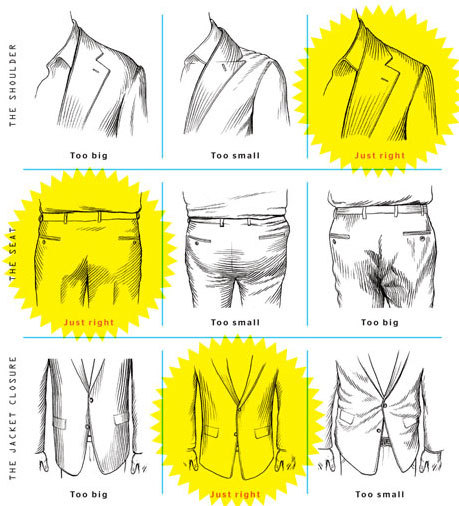
A useful guide.
voxsart:

Learn Your Basics.
Villarosa and Angeli.

A useful guide.

voxsart:

Learn Your Basics.

Villarosa and Angeli.

(via voxsart-deactivated20120827)

Clean, fluid lines all around, no pucker or pulling. An impeccable fit that you should keep in mind next time you buy a suit or sport coat.
voxsart:

99% Humidity August 1st.
Mystery Bespoke Tailor (MBT™) suit in J. & J. Minnis 8/9oz Fresco; Dege & Skinner (Robert Whittaker) bespoke shirt in Acorn Grassmere; Sam Hober (David Hober) bespoke grenadine tie; Tammis Keefe printed linen square c.1950s; Edward Green oxfords.

Clean, fluid lines all around, no pucker or pulling. An impeccable fit that you should keep in mind next time you buy a suit or sport coat.

voxsart:

99% Humidity August 1st.

Mystery Bespoke Tailor (MBT™) suit in J. & J. Minnis 8/9oz Fresco; Dege & Skinner (Robert Whittaker) bespoke shirt in Acorn Grassmere; Sam Hober (David Hober) bespoke grenadine tie; Tammis Keefe printed linen square c.1950s; Edward Green oxfords.

(via voxsart-deactivated20120827)