Notice that PG’s trousers sit above his hip bones, and while they’re slim, they’re not as skinny and pegged as the ones you typically see on fashion-conscious men. There are obviously many silhouettes a man can choose from, and few of them are objectively “wrong.” However, I personally find this classically grounded look to be better proportioned and more appealing. 
mostexerent:

Sans jacket..
| Oakley Froggies | bespoke OCBD | MTM P Johnson “Soraro” pantaloons | LeatherSoul Alden shell Cordovan “LongWongs” |

Notice that PG’s trousers sit above his hip bones, and while they’re slim, they’re not as skinny and pegged as the ones you typically see on fashion-conscious men. There are obviously many silhouettes a man can choose from, and few of them are objectively “wrong.” However, I personally find this classically grounded look to be better proportioned and more appealing. 

mostexerent:

Sans jacket..

| Oakley Froggies | bespoke OCBD | MTM P Johnson “Soraro” pantaloons | LeatherSoul Alden shell Cordovan “LongWongs” |

Quarter for your Thoughts

One of the most important areas to pay attention to when examining the fit of a suit or sport coat is what online menswear enthusiasts like to call the “quarters.” This is the section of the jacket that sits right below the buttoning point. Professional tailors refer to the area as the “front” or “front of the skirt,” but this is just a difference in terminology. 

A jacket can be made with open or closed quarters (or, correspondingly, straight or cutaway fronts). On a jacket with open quarters, the fronts will cutaway a bit below the buttoning point. Likewise, on a jacket with closed quarters, they will fall straight down.

They’re never completely straight, of course. The lounge suit evolved from the riding coat, which was heavily shaped by King George IV. The King was one of the first royals in the 19th century to be an arbiter of fashion and taste, and he had the fronts of his riding coat cut away to make way for the saddle and horse’s flanks. It was quite unflattering on him, actually, because of his large stomach, but was indubitably la mode. Thus the fashion stuck and we now have the design on the modern lounge suit. 

What you choose for yourself is a matter of personal taste. Very closed quarters might give you a “Y-shaped” silhouette, while open quarters will make your jacket form a bit of an “X.” I personally prefer open quarters, though nothing too extreme. I like the swooping line they create from the top of the lapel down to the hem. It’s a slightly more dynamic look that I think works well on young, slim men.

Of course, people differ. A friend of mine, Cooper Frederickson, once joked that strongly open quarters looked like something Diamond Dallas Page would wear. We agreed in the end that Page is probably a strictly Men’s Warehouse kind of man, but the point is well taken. 

Pictured above: Simon Crompton on the left and Takahiro Osaki on the right. Crompton is wearing a bespoke British suit (I’ve forgotten the maker) with closed fronts while Taka is wearing something more open from Liverano & Liverano.  


Avoiding Buyer’s Regret
When you’re shopping for clothes, there are probably a dozen or more variables to consider before you make a purchase. Unfortunately, most of these considerations can get muddled, and if you don’t parse them out carefully, you can buy something for the wrong reasons. So I thought I’d rank some of the principle considerations: fit, style, construction, and branding, in that order. When deciding whether or not to buy something, go through these considerations in order of importance and you’ll minimize your likelihood of ending up with buyer’s regret. 
Fit
As they say, fit is king. The first thing anyone notices, even before style, is whether your clothes fit well. A man would look better in a well-fitting pair of jeans and a t-shirt before he would in a sloppy suit. 
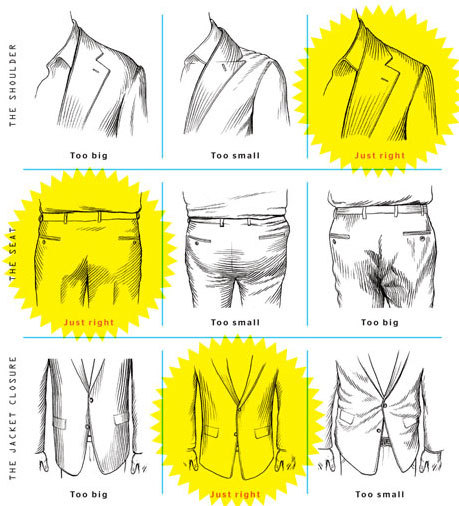
What fits is what flatters. This point may seem basic, but it’s amazing how rarely you see it practiced. Men who aren’t style conscious tend to wear clothes too big, while men who pay a lot of attention often wear things too small. Proper fitting clothes hit in the right places and give you clean lines, no matter what your movement or position. Shoulder seams should end around the shoulder bone, and clothes shouldn’t be so baggy that they fold, nor be so tight that they pull. 
Style
Always remember that fit comes before style. There’s no quicker way to catch buyer’s regret than to buy something that’s stylish, but doesn’t fit perfectly. Once you find something that fits, however, consider whether the garment has all the design details you’re looking for. If you want something that will last, avoid things that veer too strongly towards one design trend. As a very general rule of thumb, I find simple, classic designs to be best. 
You may also want to consider how versatile the garment is. Basic blues, greys, and browns will help you build in that versatility, as all those colors are easy to incorporate. To be sure, there’s a lot of room for dark greens, burgundies, and other livelier colors. However, make sure you’re not buying something that you can only wear with one pair of trousers or one jacket. You should seek to build a wardrobe, not a collection of outfits.
Construction
Some may be surprised that I rank construction so low on the list of considerations. However, a garment’s design will always be the bigger determinant of its lifespan. Most clothes are made to last at least a couple of years now. If a jacket is made with skinny lapels, for example, its style will give out much sooner than its cloth. Thus, while I strongly believe people should invest in higher quality purchases, I also think that they should prioritize fit and style above quality. If it doesn’t look good on you or work with the rest of your wardrobe, the quality of its construction will mean very little.
Branding
Finally, there is branding. Everyone succumbs to this to some extent. We buy clothes partly to express the person we are, and partly the person we wish to be. We may also buy something because of the lifestyle it represents. It may not be the most “rational” of considerations, but it’s no less real or enjoyable. Clothes in this sense are romantic; they make life less dull. It would be crotchety to deny or condemn it. At the same time, you should be aware of what you’re doing, and only do so if it meets the other criteria above. 
Conclusion
Of course, ideally, you should make purchases that fulfill every one of these categories (with the exception of maybe branding). However, people have limited means, time, and patience for such things, and not everyone is going to spend the next few months searching for the perfect shirt. Thus, for the non-neurotic, you now have neatly parsed considerations that you can prioritize in order to make better buying decisions.
Purchase things for the right reasons. Buy something because it’s well-made before you buy into a brand; buy something well designed before you buy into its quality; most importantly, buy something because it fits well before you consider anything else.

Avoiding Buyer’s Regret

When you’re shopping for clothes, there are probably a dozen or more variables to consider before you make a purchase. Unfortunately, most of these considerations can get muddled, and if you don’t parse them out carefully, you can buy something for the wrong reasons. So I thought I’d rank some of the principle considerations: fit, style, construction, and branding, in that order. When deciding whether or not to buy something, go through these considerations in order of importance and you’ll minimize your likelihood of ending up with buyer’s regret. 

Fit

As they say, fit is king. The first thing anyone notices, even before style, is whether your clothes fit well. A man would look better in a well-fitting pair of jeans and a t-shirt before he would in a sloppy suit. 

What fits is what flatters. This point may seem basic, but it’s amazing how rarely you see it practiced. Men who aren’t style conscious tend to wear clothes too big, while men who pay a lot of attention often wear things too small. Proper fitting clothes hit in the right places and give you clean lines, no matter what your movement or position. Shoulder seams should end around the shoulder bone, and clothes shouldn’t be so baggy that they fold, nor be so tight that they pull. 

Style

Always remember that fit comes before style. There’s no quicker way to catch buyer’s regret than to buy something that’s stylish, but doesn’t fit perfectly. Once you find something that fits, however, consider whether the garment has all the design details you’re looking for. If you want something that will last, avoid things that veer too strongly towards one design trend. As a very general rule of thumb, I find simple, classic designs to be best. 

You may also want to consider how versatile the garment is. Basic blues, greys, and browns will help you build in that versatility, as all those colors are easy to incorporate. To be sure, there’s a lot of room for dark greens, burgundies, and other livelier colors. However, make sure you’re not buying something that you can only wear with one pair of trousers or one jacket. You should seek to build a wardrobe, not a collection of outfits.

Construction

Some may be surprised that I rank construction so low on the list of considerations. However, a garment’s design will always be the bigger determinant of its lifespan. Most clothes are made to last at least a couple of years now. If a jacket is made with skinny lapels, for example, its style will give out much sooner than its cloth. Thus, while I strongly believe people should invest in higher quality purchases, I also think that they should prioritize fit and style above quality. If it doesn’t look good on you or work with the rest of your wardrobe, the quality of its construction will mean very little.

Branding

Finally, there is branding. Everyone succumbs to this to some extent. We buy clothes partly to express the person we are, and partly the person we wish to be. We may also buy something because of the lifestyle it represents. It may not be the most “rational” of considerations, but it’s no less real or enjoyable. Clothes in this sense are romantic; they make life less dull. It would be crotchety to deny or condemn it. At the same time, you should be aware of what you’re doing, and only do so if it meets the other criteria above. 

Conclusion

Of course, ideally, you should make purchases that fulfill every one of these categories (with the exception of maybe branding). However, people have limited means, time, and patience for such things, and not everyone is going to spend the next few months searching for the perfect shirt. Thus, for the non-neurotic, you now have neatly parsed considerations that you can prioritize in order to make better buying decisions.

Purchase things for the right reasons. Buy something because it’s well-made before you buy into a brand; buy something well designed before you buy into its quality; most importantly, buy something because it fits well before you consider anything else.

Q and Answer: What Size Overcoat Should I Wear?
William asks: If I wear a 38 regular blazer, what size overcoat should I be looking for? 
You should look for your suit and blazer size when buying an overcoat. Manufacturers size with the expectation that you’ll be wearing an overcoat that you’ll be wearing an overcoat over a suit jacket or sport coat. If you wear a size 38 jacket, you’ll want a size 38 overcoat.
If you don’t expect to wear the overcoat on top of another jacket, you may want to consider sizing down one size. And of course you’ll always want to try on or check measurements, as they vary from manufacturer to manufacturer. While the vast majority of brands size overcoats by coat size, it’s not universal.
Generally speaking, you’ll want the chest of the overcoat to measure 2” larger than your actual chest size for a snug fit, and 4” or so larger than your actual chest to fit over a suit jacket.

Q and Answer: What Size Overcoat Should I Wear?

William asks: If I wear a 38 regular blazer, what size overcoat should I be looking for?

You should look for your suit and blazer size when buying an overcoat. Manufacturers size with the expectation that you’ll be wearing an overcoat that you’ll be wearing an overcoat over a suit jacket or sport coat. If you wear a size 38 jacket, you’ll want a size 38 overcoat.

If you don’t expect to wear the overcoat on top of another jacket, you may want to consider sizing down one size. And of course you’ll always want to try on or check measurements, as they vary from manufacturer to manufacturer. While the vast majority of brands size overcoats by coat size, it’s not universal.

Generally speaking, you’ll want the chest of the overcoat to measure 2” larger than your actual chest size for a snug fit, and 4” or so larger than your actual chest to fit over a suit jacket.

Understanding a Suit’s Silhouette

It’s common to hear people describe a suit’s silhouette in terms of its nationality. Suits are described as being American, British, or Continental. The first is either a sack or modified sack silhouette; the second said to be built up with military shoulders and have more waist suppression; and the third said to be a bit slimmer and feature “natural shoulders”. This is roughly correct, though it stays truer for some countries than others. Jesse, for example, did a wonderful job of describing the traditional American style of suits a few months ago. His description really works for America because of how large J Press looms in our sartorial history. For a country like Italy, however, it can be a bit more diverse. For example, a Neapolitan jacket can be very different from a Roman one, and some would say that Naples itself is also too heterogeneous to categorize. Thus, it can be useful to break down the silhouette of a suit into parts and not just think of them nationally. By doing so, you can better understand what you like or don’t like about a particular suit, and be better equipped to find one that best fits your personal sense of style.

At the most basic level, a suit’s silhouette can be said to be either structured or soft. A structured suit will be made with a stiffer canvas and have a more built up, padded shoulder. A softer silhouette will, naturally, be made with a softer canvas and have a thinner layer of padding. A related issue, though not exactly the same, is the shoulder’s expression. A shoulder can be roped, natural, or bald. The first will have a prominent ridge at the shoulder seam that runs along the crown of the sleeve. The second will have a very light ridge, but run flat. The third will have a knocked down shoulder seam and very low profile. Jeffery Diduch did a great job of explaining the differences between shoulder expressions here. The takeaway is that while some expressions may be associated with specific styles of construction - for example, the bald shoulder with a softly constructed, unpadded shoulder line - they don’t necessarily have to go together. They’re two separate elements that work in concert with each other to make up what we see as the shoulder, which in turn gives us the impression of a structured or soft silhouette.

The minimally padded, softer silhouette is more popular these days, but that doesn’t necessarily mean you should wear it. One of the important lessons taught by Alan Flusser is that we should dress to our body types, not what happens to be fashionable. A friend of mine in San Francisco, for example, has a very round upper chest, as well as round, sloping shoulders with prominent blades. In a soft Neapolitan jacket, he looks like an gorilla, but in something more structured and with a nipped waist, he looks athletic and handsome. As always, it’s best to try both of these styles on and be objective about how you look in each.

The other important aspect to a suit is how lean or full it is. In the most basic sense, this is about how close the suit sits to your body. Unfortunately, the trend of slimmer fitting clothes has led men to be single minded about this subject, but a better understanding is more nuanced. We can think of the suit in three parts - the chest, waist, and skirt (the skirt is simply the part of the jacket that hangs below the waist).

A lean chest will be shallow while a full chest will either be swelled or draped. A swelled chest will be fuller all around and look a bit more sculpted. A draped chest will have large, vertical folds of excess cloth that “drape” along the jacket’s edges, near the armholes. I made a post about drapes and swells at my other blog some time ago, and you can see illustrations of it there. The two often go together, but they don’t have to. You can have a swelled chest, for example, with no drape.

Similar to the chest, the waist can be nipped or left loose, and the skirt can hug the hips or be left a little full. These will create either a leaner or fuller silhouette, depending on how you combine these constructions.

The “lean and clean” look is what men’s fashion magazines have been pushing for years, and probably what has been most popular with men for decades. This silhouette will sit closer to the wearer’s body in all three sections. A fuller silhouette is less popular, but I think unjustly so. I don’t just mean the dartless American sack suits here, either. Anderson & Sheppard, for example, makes a fuller chest that gently billows out a bit. I find the effect more masculine, heroic, and elegant. I once read Michael Alden compare someone’s “lean and clean” suit to an overly skinny runway model that needed more “meat on her bones.” Setting aside my slight uncomfortableness with talking about people in this way, his description spoke well to how I feel about these kinds of silhouettes in general. Of course, this is all a matter of personal taste and style, but I find fuller suits to have more depth and elegance, and be infinitely more interesting. Not that everyone should share my taste, of course, but I do think that most men should consider fuller suits more.

Moving on to the last dimension, a suit’s silhouette can either be elongating or widening. There are many aspects to this. An elongating suit will have a lower buttoning point. This will draw longer vertical lines along the suit’s lapel, which in turn will make the wearer look a bit taller. It may also have a higher gorge. A suit’s “gorge” is often conflated with the lapel’s notch, but it’s actually the seam that connects the jacket’s collar to the lapel. More or less the same, but still slightly different. Italians tend to make suits with a higher gorge than their British counterparts, and Neapolitan and Sicilian tailors make them higher still.

A widening silhouette will have wider lapels and perhaps extended shoulders. In today’s single-mindedness about suits, this may sound unappealing, but it’s worth reminding that many Neapolitan suits, which so many people are in love with nowadays, often have widening silhouettes.

In the end, all of these aspects can be combined in a number of ways to create an overall silhouette. One of the most elegantly dressed men I’ve ever met wore a softly constructed suit with a bald shoulder. His jacket had a fuller chest, nipped waist, and tight skirt. His trousers had a slightly higher rise and the legs were fuller than what more “fashionable” men wear today. They were still slim and flattering, however, and they created a nice line going from his jacket to his shoes. What he wore matched not only his body type, but also his personality and character. As a man, he was every bit as elegant as his clothes, and what he wore expressed him as a full human being, not as a clotheshorse.

As you look at pictures of well-dressed men, try dissecting each of these parts. You’ll develope a more refined understanding of suits and become more sensitive to how they can make an impression. Perhaps most importantly, you’ll be better equipped to purchase suits according to your body type and sense of style. Maybe you like lean, structured suits, or maybe you don’t, but you won’t know until you understand how to look for them.

Pictures taken from The Armoury, Permanent Style, The Sartorialist, Mister Crew, Rubinacci Club, and a few others I’ve unfortunately forgotten. This article also owes a lot to Michael Anton’s original article on the same subject at the London Lounge, so many thanks to him for that.

I strongly agree with our friend here, GW. Most trousers these days either sit below or just at your hips. In my opinion, this gives you odd proportions and makes your torso look unnaturally long. It’s much better, I think, to have your trousers come up a few inches higher. 
I don’t necessarily wear my pants at my natural waist, but my waistband seam does sit above my hipbones. This means that the pants themselves come up to my navel. If you think this will make you look geriatric, look at these pictures and ask yourself - does GW look old or just better proportioned? 
Lastly, you should know that according to the Canadian Medical Association Journal, low rise pants can give you medical problems. Consult your doctor before wearing “hipsters.” 
mostexerent:

Yes - I sometimes tuck but always wear my pantaloons at my natural waist not on my hips.
*Hipsters are better for jeans or on women or boys..

I strongly agree with our friend here, GW. Most trousers these days either sit below or just at your hips. In my opinion, this gives you odd proportions and makes your torso look unnaturally long. It’s much better, I think, to have your trousers come up a few inches higher. 

I don’t necessarily wear my pants at my natural waist, but my waistband seam does sit above my hipbones. This means that the pants themselves come up to my navel. If you think this will make you look geriatric, look at these pictures and ask yourself - does GW look old or just better proportioned? 

Lastly, you should know that according to the Canadian Medical Association Journal, low rise pants can give you medical problems. Consult your doctor before wearing “hipsters.” 

mostexerent:

Yes - I sometimes tuck but always wear my pantaloons at my natural waist not on my hips.

*Hipsters are better for jeans or on women or boys..

Q and Answer: Which Shirt Cuff Button Do I Use?
Brandon asks: I was wondering which button to use on a barrel cuff shirt.  There  are two buttons to fasten my sleeves, those that would make the cuff  tighter and those that would allow them to be looser.
This is an easy one!
As Carl Goldberg demonstrated in our “Body” episode, commercial cuffs are almost always too big, not too small. They should never be able to slide further than the midway point between your wrist and thumb.
That means you should always use the button that makes the cuff smaller, unless you’re wearing a very large watch or have exceptionally big wrists.

Q and Answer: Which Shirt Cuff Button Do I Use?

Brandon asks: I was wondering which button to use on a barrel cuff shirt.  There are two buttons to fasten my sleeves, those that would make the cuff tighter and those that would allow them to be looser.

This is an easy one!

As Carl Goldberg demonstrated in our “Body” episode, commercial cuffs are almost always too big, not too small. They should never be able to slide further than the midway point between your wrist and thumb.

That means you should always use the button that makes the cuff smaller, unless you’re wearing a very large watch or have exceptionally big wrists.

Our friend PG (aka MistahWong) has some great reminders about fit on his blog Most Exerent. (Not least of which is: “Jacket MUST cover your ASS”).

Our friend PG (aka MistahWong) has some great reminders about fit on his blog Most Exerent. (Not least of which is: “Jacket MUST cover your ASS”).

Rise is Important
I strongly believe that pants look best when they sit on, not just at, your hips.
Where your pants sit on you is determined by your rise, which is the distance from your crotch seam to the top of your waistband. The trend, unfortunately, is for low-rise pants, which often sit below the hips. If you’re lucky, you can sometimes find pants that sit at your hips. If you look harder still, you can find pants that sit on your hips. The last is what I think looks best on all men. 
Assuming you tuck in your shirt (which you should be), there are two unfortunate effects when your pants sit too low. The first is that your torso looks unnaturally long, thus ruining your proportions. The second is that you’ll look heavier, especially if you already have a gut. Very few men are skinny enough for low rise pants to not have this effect. 
The photo above shows two men, one with low-rise jeans and the other with a higher rise pair of trousers. The one on the left is skinny enough to not look heavy with his jeans, but his torso still looks unnaturally long. The man on the right, on the other hand, has his proportions down. Most importantly, he looks like a grown man, not an adolescent.
When buying pants, make sure your trousers sit on you properly. On my 30 inch waist trousers, I like my rise to be around 10 to 10.25 inches, but your personal tastes and body proportions may differ. 

Rise is Important

I strongly believe that pants look best when they sit on, not just at, your hips.

Where your pants sit on you is determined by your rise, which is the distance from your crotch seam to the top of your waistband. The trend, unfortunately, is for low-rise pants, which often sit below the hips. If you’re lucky, you can sometimes find pants that sit at your hips. If you look harder still, you can find pants that sit on your hips. The last is what I think looks best on all men. 

Assuming you tuck in your shirt (which you should be), there are two unfortunate effects when your pants sit too low. The first is that your torso looks unnaturally long, thus ruining your proportions. The second is that you’ll look heavier, especially if you already have a gut. Very few men are skinny enough for low rise pants to not have this effect. 

The photo above shows two men, one with low-rise jeans and the other with a higher rise pair of trousers. The one on the left is skinny enough to not look heavy with his jeans, but his torso still looks unnaturally long. The man on the right, on the other hand, has his proportions down. Most importantly, he looks like a grown man, not an adolescent.

When buying pants, make sure your trousers sit on you properly. On my 30 inch waist trousers, I like my rise to be around 10 to 10.25 inches, but your personal tastes and body proportions may differ. 

The “Fit” and Proportions of a Your Tie
The fit of your tie is just as important as your other garments, and this is made up of the width of your ties at their widest point, as well as their length. 
The width is a matter of personal style, proportions, and trends. Personally, I think 8cm looks best on most men, but you can fudge a centimeter in either direction depending your body type and taste. Popular wisdom says larger men should wear wider ties, and that the width of your ties should generally match the width of your lapels. You have some wiggle room depending on your size and style, but the general spirit is to keep your proportions in balance. 
The length has less wiggle room. For whatever reason, men always wear their ties too short (see Sir Bryan Ferry, pictured above, who for whatever reason chronically does this). The tip of your tie, however, ought to be around the middle of your waistband. It doesn’t have to exact, but it should be close. Your ability to achieve this will depend on how tall you are, where your waistband hits, and whether you have the correctly sized tie.
If you find that your ties are too long, try the double four in hand, which I’ve written about here. If your ties are too short, buy extra long ties. If you find nothing in the market works for you, try getting custom made ties. The most affordable of custom tie makers is Sam Hober, who happens to also make some of the best ties on the market. Other makers include EG Cappelli, Drake’s, and a number of tailors such as Rubinacci and Napoli Su Misura. Remember, also, that the back blade should somewhat match the front. If the tip of your back blade is more than three inches away from the tip of the front blade, you may need to look into custom ties. 
Again, regardless of your personal preference for width and where the back blade ends, always make sure that the front blade should is close to the middle of your waistband. 

The “Fit” and Proportions of a Your Tie

The fit of your tie is just as important as your other garments, and this is made up of the width of your ties at their widest point, as well as their length. 

The width is a matter of personal style, proportions, and trends. Personally, I think 8cm looks best on most men, but you can fudge a centimeter in either direction depending your body type and taste. Popular wisdom says larger men should wear wider ties, and that the width of your ties should generally match the width of your lapels. You have some wiggle room depending on your size and style, but the general spirit is to keep your proportions in balance. 

The length has less wiggle room. For whatever reason, men always wear their ties too short (see Sir Bryan Ferry, pictured above, who for whatever reason chronically does this). The tip of your tie, however, ought to be around the middle of your waistband. It doesn’t have to exact, but it should be close. Your ability to achieve this will depend on how tall you are, where your waistband hits, and whether you have the correctly sized tie.

If you find that your ties are too long, try the double four in hand, which I’ve written about here. If your ties are too short, buy extra long ties. If you find nothing in the market works for you, try getting custom made ties. The most affordable of custom tie makers is Sam Hober, who happens to also make some of the best ties on the market. Other makers include EG Cappelli, Drake’s, and a number of tailors such as Rubinacci and Napoli Su Misura. Remember, also, that the back blade should somewhat match the front. If the tip of your back blade is more than three inches away from the tip of the front blade, you may need to look into custom ties. 

Again, regardless of your personal preference for width and where the back blade ends, always make sure that the front blade should is close to the middle of your waistband.