
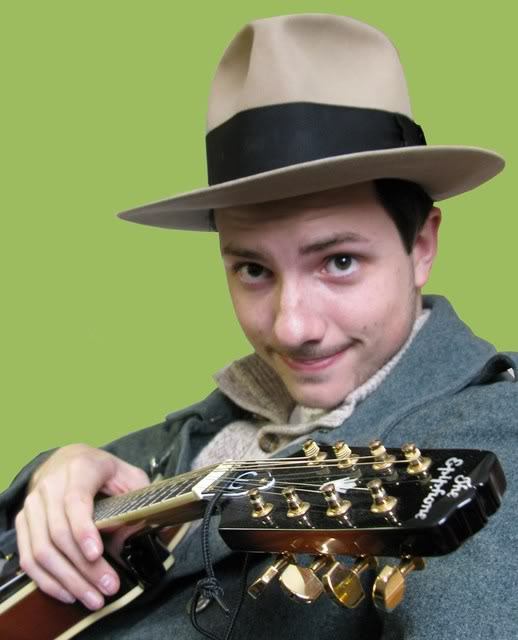
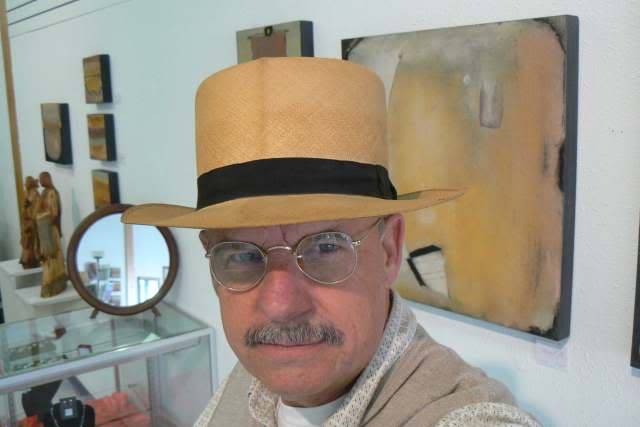

“The tweed hat is favored by men of intellect and science, who would not wish either their foreheads or their thinking to be restricted by rigid hats.” — Bernhard Roetzel, “Gentleman: A Timeless Guide to Fashion
“Never wear a hat that has more character than you.”

Utah Phillips

(thanks, Mike)

Q and Answer: What Makes a Quality Men’s Hat?
Ian writes: Your posts have repeatedly stressed the importance of quality hats, and explained that it’s very hard to find any newly made hats that aren’t prohibitively expensive that are of the necessary quality. What, other than the price, separates a $500+ hat from Optimo from, say, something in Goorin’s ~$120 American Made line?
That’s a great question, Ian. There are different kinds of hats, so I’ll address each type separately.
Flat caps and other wool and cotton caps are a lot like other types of apparel. You’ll find that finer makers use higher-quality materials and construction techniques. I have a couple of Borsalino flat caps that are about fifteen years old. They’ve got silk satin liners and beautiful tweed outers. There’s a difference in quality between them and what I might buy at Macy’s. Still, the spread on price is probably much larger than on quality in this area. If you can find good hats of this type made of quality materials for a lesser price, go for it. Watch out for the polyester that dominates the lower end of the market, though.
With Panama and other straw hats, it’s the weave that makes the difference. Quality Pananamas are flexible, not stiff, and they’re made of soft, fine fibers. There are advantages to a less dense weave - it will wear cooler - but the mark of quality is weave density. A denser, finer weave is more labor-intensive to produce, and thus more expensive to buy. What you’ll find, though, is that it gives the hat a more finished appearance, and much more life. There are still makers who make high-quality Panamas, but they’re tough to find. Optimo, who you mentioned, are one.
As with Panamas, there’s a huge range in quality with fur felt hats. Lower-quality hats, like the ones you asked about, are made with wool felt. Better hats are often made with coney or rabbit fur felt. The best are made with beaver felt. Of course, the beaver-trapping industry isn’t what it once was, so it can be tough to find beaver hats these days outside of specialty custom makers (like Optimo).
A high-quality felt hat has a dense finish. This is a result of the felting process - the fur is crushed and shrunk repeatedly as it is transformed from fur to felt. It can be a variety of different weights, but it will always be strong and resilient. Note that I wrote resilient, and not hard - like good wool, one of the defining characteristics of a good felt hat is that it retains its shape when distorted. It will have a strong shape, but it will not be stiff.
The reality is that as the hat industry has shrunk over the past fifty years, the quality of hats has plummeted. It’s easy to see when you handle a model that’s been made continuously since the heyday of hats, like the Stetson Open Road, which was LBJ’s signature western hat. The example from the 1950s or before and the current model are the same shape, but the quality is like night and day. The current model is stiff, rough and lifeless. When you have a feeling for this difference, you can spot the crap on sight, and you’ll know the Dad Who Thinks He Looks Like Indiana Jones Hats from the Good Stuff.
There are custom makers, who source high-quality beaver from European plants and still make hats as good as the mass-market hats of the 50s and before. There are also a few boutique operations like Optimo (or the English Lock & Company) who maintain the same high standards. The sad fact, though, is that if you walk into a hat store in the United States, even a specialty hat store, you’re likely to find a bunch of junk. Even storied brands like Borsalino sell C+ hats at extraordinary prices.
The best way to experience the difference is to feel it for yourself. If you’re lucky enough to live in Chicago or London, you can just head into Optimo or Lock. If you’re not, first head to your local hat store and feel a hundred-dollar Stetson. Then head to a good vintage store and feel a 1940s Dobbs or Cavanaugh. You’ll understand the difference quickly.
Luckily, there’s a good solution. There are still plenty of hats in the world from the golden age of hats, but there are now many less hat wearers. That means that you can find the good stuff - like top of the line Borsalinos, Dunlaps, Dobbs and Stetsons - for as little as $50, and rarely more than $200.

Q and Answer: What Makes a Quality Men’s Hat?

Ian writes: Your posts have repeatedly stressed the importance of quality hats, and explained that it’s very hard to find any newly made hats that aren’t prohibitively expensive that are of the necessary quality. What, other than the price, separates a $500+ hat from Optimo from, say, something in Goorin’s ~$120 American Made line?

That’s a great question, Ian. There are different kinds of hats, so I’ll address each type separately.

Flat caps and other wool and cotton caps are a lot like other types of apparel. You’ll find that finer makers use higher-quality materials and construction techniques. I have a couple of Borsalino flat caps that are about fifteen years old. They’ve got silk satin liners and beautiful tweed outers. There’s a difference in quality between them and what I might buy at Macy’s. Still, the spread on price is probably much larger than on quality in this area. If you can find good hats of this type made of quality materials for a lesser price, go for it. Watch out for the polyester that dominates the lower end of the market, though.

With Panama and other straw hats, it’s the weave that makes the difference. Quality Pananamas are flexible, not stiff, and they’re made of soft, fine fibers. There are advantages to a less dense weave - it will wear cooler - but the mark of quality is weave density. A denser, finer weave is more labor-intensive to produce, and thus more expensive to buy. What you’ll find, though, is that it gives the hat a more finished appearance, and much more life. There are still makers who make high-quality Panamas, but they’re tough to find. Optimo, who you mentioned, are one.

As with Panamas, there’s a huge range in quality with fur felt hats. Lower-quality hats, like the ones you asked about, are made with wool felt. Better hats are often made with coney or rabbit fur felt. The best are made with beaver felt. Of course, the beaver-trapping industry isn’t what it once was, so it can be tough to find beaver hats these days outside of specialty custom makers (like Optimo).

A high-quality felt hat has a dense finish. This is a result of the felting process - the fur is crushed and shrunk repeatedly as it is transformed from fur to felt. It can be a variety of different weights, but it will always be strong and resilient. Note that I wrote resilient, and not hard - like good wool, one of the defining characteristics of a good felt hat is that it retains its shape when distorted. It will have a strong shape, but it will not be stiff.

The reality is that as the hat industry has shrunk over the past fifty years, the quality of hats has plummeted. It’s easy to see when you handle a model that’s been made continuously since the heyday of hats, like the Stetson Open Road, which was LBJ’s signature western hat. The example from the 1950s or before and the current model are the same shape, but the quality is like night and day. The current model is stiff, rough and lifeless. When you have a feeling for this difference, you can spot the crap on sight, and you’ll know the Dad Who Thinks He Looks Like Indiana Jones Hats from the Good Stuff.

There are custom makers, who source high-quality beaver from European plants and still make hats as good as the mass-market hats of the 50s and before. There are also a few boutique operations like Optimo (or the English Lock & Company) who maintain the same high standards. The sad fact, though, is that if you walk into a hat store in the United States, even a specialty hat store, you’re likely to find a bunch of junk. Even storied brands like Borsalino sell C+ hats at extraordinary prices.

The best way to experience the difference is to feel it for yourself. If you’re lucky enough to live in Chicago or London, you can just head into Optimo or Lock. If you’re not, first head to your local hat store and feel a hundred-dollar Stetson. Then head to a good vintage store and feel a 1940s Dobbs or Cavanaugh. You’ll understand the difference quickly.

Luckily, there’s a good solution. There are still plenty of hats in the world from the golden age of hats, but there are now many less hat wearers. That means that you can find the good stuff - like top of the line Borsalinos, Dunlaps, Dobbs and Stetsons - for as little as $50, and rarely more than $200.

You might not have guessed it from reading this blog, but I love baseball caps. That said, I’m pretty picky about them. The hard-crown, made-in-China version that passes for pro wear today won’t cut it for me. I used to be a partisan of Cooperstown Ballcaps, but they recently shut down. I was pretty bummed about that, and you’ll still find Cooperstown caps in eBay roundups from time to time, but my wife has renewed my faith in what I’d consider the single most distinctively American garment.

She recently gave me a San Francisco Missions hat by Ebbets Field Flannels. It doesn’t have a few of the features I loved about Cooperstown Ballcaps - leather sweatbands and low crowns among them - but it’s really a very good-looking piece. It’s made in the USA, has a bill with a green satin underside, and has a nice soft crown.

I was quite the baseball nerd in my youth, and even went to a few Society for American Baseball Research conferences as a teenager, but I didn’t know the history of the Missions. They were also known as the Monks or the Mission Reds, and played as a second San Francisco team (after the Seals) from 1926-1937.

What genuinely blew my mind is that while starting in 1931 they shared Seals Stadium (which was in Potrero Hill, where the San Francisco Autocenter used to be, and where there’s now a Ross, a Lane Bryant and a Boston Market, among other shitty businesses) with the Seals, they also played in a stadium called Recreation Park. It occupied the site of what’s now the housing project Valencia Gardens, right in the heart of the Mission.

Not only did I grow up in the Mission, but I grew up half a block from where the ballpark once was. Of course, I knew the block as the site of various childhood traumas (an assault or two, a lot of crack-selling, gunshots at night). It’s kind of magical for me to imagine that place transformed into a ballpark for a team named after my home neighborhood. An added advantage is that I can wear it to rep my home town here in LA without getting beaten into a coma.

A couple of years ago, my mom (a part-time antiques dealer) came across some panama hats at an estate sale. She grabbed them, because she recognized them as quality pieces. Boy were they.
They were from Chicago’s Optimo Hats, America’s premiere custom hatter. Perhaps in season three of Put This On we’ll get the chance to visit Optimo, and I’ll get the chance to thank them for the hat my mom saved for me… and they stretched to my size.
If you’re in Chicago, stop by Optimo, one of the only real hat stores left in the US - no silly mall-kiosk BS. Real, quality hats. If you’re not, check out some gorgeous pictures and the story of the shop at Gentleman’s Gazette.

A couple of years ago, my mom (a part-time antiques dealer) came across some panama hats at an estate sale. She grabbed them, because she recognized them as quality pieces. Boy were they.

They were from Chicago’s Optimo Hats, America’s premiere custom hatter. Perhaps in season three of Put This On we’ll get the chance to visit Optimo, and I’ll get the chance to thank them for the hat my mom saved for me… and they stretched to my size.

If you’re in Chicago, stop by Optimo, one of the only real hat stores left in the US - no silly mall-kiosk BS. Real, quality hats. If you’re not, check out some gorgeous pictures and the story of the shop at Gentleman’s Gazette.

The Power of the Jiffy Steamer: Jiffy J-2000 Review
For years I’d been hearing and reading about the power of steamers, but I never quite believed what I heard. “What’s wrong with an iron?” was my usual response.
Then we moved my office into what had been the master bedroom of our place - a room with its own little bathroom. I figured since I had the space, I might as well give steamers a try.
All my research indicated that when it comes to steamers, Jiffy is king. It’s the only brand I’ve ever seen people in the know - like costumers and vintage clothing dealers - use. I read on the style fora that other steamers might get a B-, but the Jiffy was an A.
Luckily, I live in LA, the world capital of showbiz, so there are decommissioned stylist and costumer steamers freely available on Craigslist. I drove out to Mid-City Los Angeles, plunked down eighty bucks cash to a man whose wife was leaving the business, and drove home with a Jiffy J-2000. Jiffy makes a few sizes - there’s a travel version, a commercial version (the J-4000) and this one, which is for residential use.
This thing was absolutely worth the hype. I just bought a lot of 15 or 20 ties on eBay that came in one huge ball, inside a Five Guys burger box. I thought they were ruined - dry cleaning or pressing ties flattens and destroys them. Then I remembered my steamer. Ten minutes later, they were as smooth as the day I bought them.
It’s also helped me avoid the dry cleaner with other clothes. I’ve got some cotton dry-clean-only trousers that I’d much rather clean once every two or three wearings that steam beautifully in between cleanings. My wool jackets and trousers I’d prefer to subject to dry cleaning no more than once a year - now a quick brushing and steaming and they’re good as new. I even used it to help re-size a hat.
The J-2000 is big and industrial-looking. If you haven’t got a broom closet to keep it in, you might want to consider the hand-held travel version. Either way, a steamer is a remarkably useful tool, and Jiffy is the way to go.

The Power of the Jiffy Steamer: Jiffy J-2000 Review

For years I’d been hearing and reading about the power of steamers, but I never quite believed what I heard. “What’s wrong with an iron?” was my usual response.

Then we moved my office into what had been the master bedroom of our place - a room with its own little bathroom. I figured since I had the space, I might as well give steamers a try.

All my research indicated that when it comes to steamers, Jiffy is king. It’s the only brand I’ve ever seen people in the know - like costumers and vintage clothing dealers - use. I read on the style fora that other steamers might get a B-, but the Jiffy was an A.

Luckily, I live in LA, the world capital of showbiz, so there are decommissioned stylist and costumer steamers freely available on Craigslist. I drove out to Mid-City Los Angeles, plunked down eighty bucks cash to a man whose wife was leaving the business, and drove home with a Jiffy J-2000. Jiffy makes a few sizes - there’s a travel version, a commercial version (the J-4000) and this one, which is for residential use.

This thing was absolutely worth the hype. I just bought a lot of 15 or 20 ties on eBay that came in one huge ball, inside a Five Guys burger box. I thought they were ruined - dry cleaning or pressing ties flattens and destroys them. Then I remembered my steamer. Ten minutes later, they were as smooth as the day I bought them.

It’s also helped me avoid the dry cleaner with other clothes. I’ve got some cotton dry-clean-only trousers that I’d much rather clean once every two or three wearings that steam beautifully in between cleanings. My wool jackets and trousers I’d prefer to subject to dry cleaning no more than once a year - now a quick brushing and steaming and they’re good as new. I even used it to help re-size a hat.

The J-2000 is big and industrial-looking. If you haven’t got a broom closet to keep it in, you might want to consider the hand-held travel version. Either way, a steamer is a remarkably useful tool, and Jiffy is the way to go.

An Uptown Dandy visits JJ Hat Center in New York
“Works Fine.” - LIFE Mag.
(via BB)

“Works Fine.” - LIFE Mag.

(via BB)

[Flash 9 is required to listen to audio.]

My people at WNYC come through with a lovely piece on New York’s JJ Hat Center, which celebrates its 100th anniversary this year. Click through for a longer interview with one of their veteran salesmen.