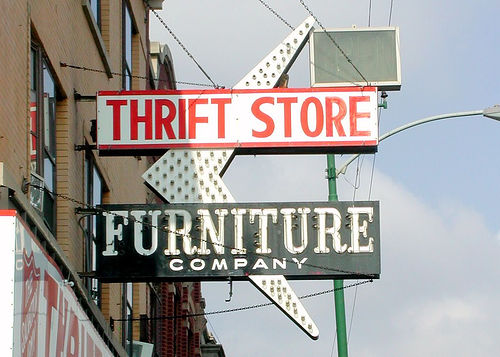
Go thrifting on a Sunday afternoon, and you never know what you’ll find. It was a pretty nice coat, too, so if anyone lives in LA (and is 6’11”), Hollywood Goodwill has a nice treat for you.
A Guide to Ebay Shopping for Men’s Clothes
eBay can be a wonderful source for men’s clothing at a significant discount. Rarely will you find clothes for thrift store prices (particularly when factoring in the cost of shipping), but you’ll also rarely pay retail. The keys to shopping on eBay are patience and strategy. Here are some tips.
- Search effectively. Particularly in clothing categories, searches can be very granular. There’s no need to browse suits that aren’t your size, for example. Pick you keywords careful, and refine by size and type of clothing.
- Know your brands. The best-known brands command a premium - you will rarely find a deal on Armani. Dig a little deeper, however, and you may well find a great piece by, say, the Savile row tailor Huntsman, or the now-defunct luxury clothing maker Sulka. Do research on lesser-known high-quality brands, and use them as keywords.
- Watch out for diffusion lines. Many designer brands offer many levels of clothing. Ralph Lauren’s “Purple Label” line is one of the better ready-to-wear brands in the world. Ralph Lauren’s “Lauren” line is sold at JC Penney. This is doubly true for vintage clothes - many designers followed Pierre Cardin and Christian Dior into a world of low-quality licensing in menswear in the 1960s-1990s.
- Know your retailers. For many years, high-end menswear was sold by local retailers. In some cases, it still is. A search for, say, San Francisco’s Wilkes Bashford, including the full text of the listing, can turn up treasures. Most suits and accessories featured branding from both the store and the manufacturer, and the store information will typically be included in the text of the listing.
- Know your size. I don’t just mean your shirt and coat size, waist and inseam (though that’s a good start). I mean your full measurements. How long is your coat sleeve? How wide are your shoulders? A soft measuring tape can be bought in the sewing section of your grocery or drug store. Measure clothes that fit you very well, and compare them to measurements posted for items on eBay. If there are no measurements in a listing, ask for them. Be aware of what’s alterable (shortening pants, for example) and what isn’t (like broadening a coat’s shoulders). Additionally: when buying shoes, know that all lasts (the interior shape on which the shoe is built) will not fit the same.
- Know your sellers. When I find a great piece in my size, I always check the seller’s other items. They’re often either selling pieces from their own closet, in which case they’ll all be my size (and are likely to be to my taste), or they’re selling from another source, like an outlet store, and have many items in a similar style. Both are worth your time. Similarly, if you find sellers whose items you particularly like, follow them carefully - and remember that you can search within their stores so you don’t have to waste time on items that are the wrong size.
- Save your searches. Any eBay search can be saved - this is particularly useful when searching for tough-to-find clothes. Lock in a search for, say, 42L and Tuxedo in the vintage section, and a tux will pop up every other week or so. Be patient, and you’ll find what you want. You can subscribe to your saved searches by email, but I prefer RSS. If you use Google Reader or another RSS reader, you can subscribe to an RSS feed for almost any search by clicking the small orange RSS icon at the bottom of your results.
- Don’t buy damaged goods. If you’re not sure about the condition of an item, ask. If you don’t get a straight answer, you’re not buying from a good source. Damaged goods are rarely worth buying, but a used item in good shape is just fine.
- Don’t be (too) afraid of lousy pictures. An item with lousy pictures is a calculated risk for you - it will likely get fewer bids, but it may have surprises. Again, ask - there are plenty of honest sellers who are lousy photographers. Your ideal is a picture that is ugly enough to keep n00bz from getting excited, but clear enough that you can see the condition and style of the garment.
- Use a sniper. A sniping service will automatically bid your top amount at the last moment, to avoid starting bidding wars. I’ve used the free service Gixen for several years now, and while I’m still vaguely uncomfortable about giving it my eBay login information, I’ve never had a problem. When bidding on eBay, it’s easy to get excited about the idea of winning, and forget what an item is worth to you. When you like something, decide what it’s worth to you. Put that amount into your sniper, and let it be.
- Be patient. If you lose an auction, something else will come along. If you need something imminently, create a bid group with your sniper, and it will bid on like items until you win one. The key is that you must be dispassionate. Get locked in a head-to-head battle, and you will bid too much.
With a little care, you can get some great items for a great price.
Q and Answer
Ian writes:
You recently posted about a $60 tie. My immediate thought when I saw it (and whenever I see any shop that sells what I would term expensive ties) was are they really worth it? What do I get for my money? All my ties are £3 jobs from vintage shops or £9 things off the high street. I even bought a plain black tie for 100 yen when I desperately needed one that I still wear.
The second part of my question is this: am I only failing to see the value of more expensive ties because I find it absurd that a tie can cost more than any shirt I own and about half as much as any suit I own? Would you agree that it is absurd to wear a £60 tie if you only own a £120 suit?
Let’s start with this: is there a difference between a cheap tie and an expensive tie? The answer is an unequivocal “yes.”
The essential component in a tie is a piece of pretty fabric, usually silk. In a cheap tie, this silk is of poor quality - less attractive, prone to damage, lightweight, poorly printed. In the best ties, the silk is richer, thicker and more attractive.
In cheap ties, the manufacturers make every effort to use as little silk as possible. That means wrapping their thin layer of silk around a piece of wool, which provides the heft needed to make a knot. In good ties, this lining is of higher quality, and the secondary silk which covers the backside of the front blade is made of this same silk. In the best ties, the whole tie is made of silk, as pictured above.
The quality of these materials is apparent to the eye, but perhaps the most important quality indicator for a necktie is the quality of the knot. Poor quality neckties tie poorly - their knots lose their dimples, they lack the weight to remain uniform and so on.
Does that mean you should buy expensive neckties? Like any other piece of clothing, that depends on your means and your will.
Certainly I don’t recommend buying most neckties at full price. There are inexpensive neckties - like those from Lands’ End - which will give you solid if unspectacular quality and are often on sale. There are department store brands, like, say, Facconable (usually made by the French maker Breuer) which can similarly be found in the world’s Nordstrom Racks for $30 or so. And of course, if you have the time and a good eye, the necktie is the one item that for the vast majority of men always fits, so it’s the perfect item to buy at thrift and consignment stores.
Of course, there are challenges to this budget approach. The main one is that you’re generally picking through others’ cast-offs. The things at the thrift, the things on sale, they’re always something someone else didn’t want. That means, above all, that you will find lots of oddities and very few basics. This is true of thrift stores and sales and discount stores and the whole nine yards. When you’re dressing with oddities, you will need many more items of clothing than when you’re dressing with basics.
I find though that there are generally two kinds of men. One has many, many neckties. Whether acquired through expensive or inexpensive means, they have more ties than they can reasonably wear. That person would benefit from passing on five or six $10 ties to buy a quality tie in a classic style for $60.
The other is the man with two or three ties. Again, this is a man who for $180 could assure that he would look good, not passable, for the next ten years’ worth of necktie-required events. When you’re spending $1000 to fly to a wedding, perhaps it’s not crazy to spend $60 on a nice tie.

(me and my mom, 1981)
My mom’s current (modest) salary, as a Junior College professor, is the most she’s made in her life, and living alone in San Francisco it still barely qualifies her for the middle class. Despite that, her home is filled to the gills with beautiful things, and her wardrobe is, too. Our home was always full of beautiful things, even when I was eight or nine, and she was working her way through graduate school as a single mother in her 40s.
Partly, it’s because she’s got taste, which she’s developed over many years. In large part, though, it’s because she’s a truly great shopper. She’s taught me a lot about how to get a lot for a little, and how never to want, even when you’re broke.
What I’ve learned from her can help you build a wardrobe, no matter what your income level is.
Here’s how you can shop like my mom:
Know what you need. My dad can only shop for one thing at a time. He can shop for a new Accord and find a good deal, but if he was on his way to buy lettuce and saw a mint ‘56 Chevy for sale for $1200, he wouldn’t be able to wrap his head around buying it. My mom always knows what she needs, and what she’s going to need… and, for that matter, what everyone close to her needs. I can tell her that my wife and I need some napkins, and two months later, a bag appears at my doorstep full of linen napkins from the 50s that my mom bought for a dollar. My mom keeps a running tally in her head of what she’s low on, what might need replacing, what holes have sprung up in her material world… and when the opportunity presents itself, she strikes.
Accept that you might not get it now. If you look at your purchasing decisions as a problem that needs an immediate solution, you’ll always end up at Target or Ikea. When you actually give some consideration to what really is a “must have it now” item (roof repairs) and what’s a “when it comes along item” (new sweater), you can buy from a position of strength.
Plan ahead. A reader emailed today asking about where he could get a good, affordable winter hat. It’s November right now, and winter hat prices are at their peak. If the reader had bought a hat in February, he could have shopped at Saks instead of H&M. It’s even OK to have a little surplus of things that won’t go bad — you can buy the big box of Bisquick, or and you can buy two classic cashmere toques when they’re marked down to $19.
Used is your friend. Remember that the biggest drop in value comes when you drive that new car off the lot. The time investment may be slightly greater, but the savings is huge when you buy used, and if you know how to buy things that aren’t “used up,” (either functionally, as in pilling sweaters, or aesthetically, as in out-of-style clothes), you will benefit. You want things that are worn in, not worn out.
Buy things for less than they’re worth. My mom is a hustler. When she sees a chance to buy low, she does - when you’ve got things of value you can always trade or sell them. Don’t confuse this with buying cheap things, or even things that are marked down. A high-school friend’s dad used to buy marked-down VHS movies at the Wherehouse. He had a house full of videos, and they were all cheap, but none of them were good enough to watch, to say nothing of being good enough to sell. I know when I buy an Oxxford suit at the thrift store that if I decide I don’t like it, I can always sell it for more than I bought it for.
Buy things that hold their value. Generally I’d say buy things that increase in value, as good art or furniture does, but with clothes, that’s tough. Fashions change, and clothes are easy to damage. Remember, though, that when you tear the tags off of that shirt from H&M, its value goes from $20 to $1 in an instant. The naval peacoat I bought at a garage sale in high school is still worth two or three times the $20 I paid for it.
Buy things that are repairable. Good shirts can have their collars and cuffs replaced. Good shoes can get new soles. Good luggage can have straps replaced. Whenever possible, buy things that can be fixed, rather than discarded.
Don’t confuse price and value. Quality correlates to price, but it certainly doesn’t correlate to price directly. There’s plenty of expensive crap out there, and there are plenty of big markdowns that aren’t very useful to you. It can be tough to resist that orange cashmere sweater marked from $490 to $49 - that’s 90% off. But how valuable is an orange cashmere sweater to you? Unless you’re in a community theater production of It’s The Great Pumpkin, Charlie Brown, it may be less than $49, no matter what the original price sticker says. Similarly, brand has gone from a shorthand for quality to a shorthand for, well, brand. A tag that says “Coach” used to mean the best in leather goods. Now it means you can afford to buy Coach branded leather goods. Or knockoffs thereof.
Put yourself in a position to win. My mom’s a creative shopper. She gets up early to go to estate sales. She has tons of saved searches on Ebay. She stops at garage sales. She puts herself in a position to find something amazing, and when it comes up, she’s ready to buy. Serendipity is the child of persistence.
Know what’s good. This one’s about skill. Skill’s about talent, in part. My mom has a great natural aesthetic sense. But it’s also about knowledge. She can evaluate whether the piece of pottery in front of her really is pre-Columbian, and she knows the names of the best leather goods makers in England. What’s great is that her knowledge and experience don’t just make her a walking reference book, they also make her guesses much better. Memorizing the best makers can help you spot pieces by those makers, but learning to spot quality means that you can be confident in your own assessments.
Don’t confuse quantity and quality. When you get an $1800 sportcoat for $300, you have not bought the right to buy five $300 sportcoats. You’re living within your budget, or you’re saving money for another day. You don’t want to end up with a house full of VHS copies of Prayer of the Rollerboys.
Move up the ladder. If you have something decent, don’t buy another piece of comparable quality. It’s redundant. Buy one that’s better. You don’t want more: you want better.
Buy amazing things. My mom looks at a lot of things in a given month. When she sees something - once or twice a year - that she truly loves, she buys it. Even if it’s expensive. Then she figures out how to pay for it. If something really speaks to you, it’s worth the money.
So… think about what your ideal wardrobe is. Learn about quality. Put yourself in a position to catch lightning in a bottle. Be patient. And make it happen.
Four pocket squares, thrifted yesterday in San Francisco. Don’t buy a square unless it has full, round, hand-rolled edges.
“Thrift store optimistic”— Friend of the family Roxana, of Nerd Boyfriend, describes her personal style.