Consider the Silk Scarf
If you’re wearing a wool coat this winter, consider pairing it with a silk scarf. Silk scarves aren’t as versatile as ones made from cashmere or lambswool, but they look amazing when worn with heavy dress coats. By that I mean things such as polo coats, Ulster coats, and Chesterfields – the kinds of things that you sometimes see labeled as “dress outerwear” in places such as Brooks Brothers. It’s just another way of saying outerwear that’s dressier than things such as parkas and leather bomber jackets.
A silk scarf can really soften up the look of a heavy wool coat. See Noel Coward above or Gordon Gekko in this scene from the movie Wall Street. In both cases, their scarves in lend a nice sheen to an otherwise matte ensemble. It’s not unlike how we use silk ties and polished shoes to counterbalance the flatness of a wool sport coat or woolen trousers. As I wrote earlier this year, I believe a lot of what it means to dress well is learning how to strike a balance between different elements of what you’re wearing (patterns, texture, hardness/ softness, sheen/ flatness, etc). Light silk scarves do that well with heavy wool coats, so long as the coat is as dressy as the scarf.
There are a few places to buy a silk scarf. My favorite is Drake’s, who sells them in a few different designs. I have two of their reversible dotted tubular scarves – one in navy and one in brown – which kind of look like this, but without the fringed ends. A navy dotted silk scarf is arguably the most versatile version you can buy, though I like my brown one for when I wear navy coats. The difference in color helps distinguish it from the rest of what I’m wearing.
You can also pick some up from traditional men’s haberdashers, such as Ben Silver, Brooks Brothers, J. Press, Paul Stuart, and A Suitable Wardrobe. Additionally, San Francisco’s Wingtip stocks Edward Armah silk scarves, as well as a few under their own house label. You can also buy Edward Armah’s scarves directly from Edward Armah themselves.
Admittedly, all those are quite expensive. You could wait for them to go on sale, but they’ll still be on the pricey side. Alternatively, KJ Beckett sells silk scarves by Michelsons of London (also available through the manufacturer themselves), but I have no first hand experience with their products, so I can’t speak about their quality. You can also try eBay. This seller, for example, regularly stocks them, but his/ her scarves are often short and narrow. That’ll limit how you can wear the scarf. You may be able to get away with wearing it like a muffler underneath your buttoned up coat, but it may look silly if you try anything else. Better if you can get something 64” or longer, but those will typically cost you considerably more. 

Consider the Silk Scarf

If you’re wearing a wool coat this winter, consider pairing it with a silk scarf. Silk scarves aren’t as versatile as ones made from cashmere or lambswool, but they look amazing when worn with heavy dress coats. By that I mean things such as polo coats, Ulster coats, and Chesterfields – the kinds of things that you sometimes see labeled as “dress outerwear” in places such as Brooks Brothers. It’s just another way of saying outerwear that’s dressier than things such as parkas and leather bomber jackets.

A silk scarf can really soften up the look of a heavy wool coat. See Noel Coward above or Gordon Gekko in this scene from the movie Wall Street. In both cases, their scarves in lend a nice sheen to an otherwise matte ensemble. It’s not unlike how we use silk ties and polished shoes to counterbalance the flatness of a wool sport coat or woolen trousers. As I wrote earlier this year, I believe a lot of what it means to dress well is learning how to strike a balance between different elements of what you’re wearing (patterns, texture, hardness/ softness, sheen/ flatness, etc). Light silk scarves do that well with heavy wool coats, so long as the coat is as dressy as the scarf.

There are a few places to buy a silk scarf. My favorite is Drake’s, who sells them in a few different designs. I have two of their reversible dotted tubular scarves – one in navy and one in brown – which kind of look like this, but without the fringed ends. A navy dotted silk scarf is arguably the most versatile version you can buy, though I like my brown one for when I wear navy coats. The difference in color helps distinguish it from the rest of what I’m wearing.

You can also pick some up from traditional men’s haberdashers, such as Ben Silver, Brooks Brothers, J. Press, Paul Stuart, and A Suitable Wardrobe. Additionally, San Francisco’s Wingtip stocks Edward Armah silk scarves, as well as a few under their own house label. You can also buy Edward Armah’s scarves directly from Edward Armah themselves.

Admittedly, all those are quite expensive. You could wait for them to go on sale, but they’ll still be on the pricey side. Alternatively, KJ Beckett sells silk scarves by Michelsons of London (also available through the manufacturer themselves), but I have no first hand experience with their products, so I can’t speak about their quality. You can also try eBay. This seller, for example, regularly stocks them, but his/ her scarves are often short and narrow. That’ll limit how you can wear the scarf. You may be able to get away with wearing it like a muffler underneath your buttoned up coat, but it may look silly if you try anything else. Better if you can get something 64” or longer, but those will typically cost you considerably more. 

The Most Versatile Knit Tie

Jake over at Wax Wane already wrote about black silk knit ties this week, but I thought I’d give them another plug anyway. Black is, unexpectedly, one of the most versatile colors for knit ties. Better than the standard go-to colors for neckwear, such as brown, burgundy, and bottle green. Better even than the always wearable navy. The black silk knit was perhaps most famously worn by the literary version of James Bond, who was often described by Ian Fleming as wearing a dark suit, clean white shirt, and a “thin, black silk knitted tie.” It’s also heavily associated with other mid-century icons such as the fellas in The Rat Pack. In fact, one of the first ties I bought as an undergraduate student was a black silk knit, precisely because I thought Sammy Davis Jr. looked so great in them.

You can wear almost anything with a black silk knit tie: brown tweeds, navy jackets, or grey suits paired with white or light blue shirts in solids, stripes, or checks (knit ties are especially nice with checks). Given that many men today want to wear a tie without looking too formal, the black silk knit is about as good as you can get. Versatile in color; casual in form.

There are many places to score one. On the high-end, we have Drake’s, who makes them in a rather unique weave. They’re also commonly found at traditional American haberdasheries, such as Ben SilverBrooks Brothers, and J. Press (the last of which is having a 25% off sale right now). Additionally, Howard YountKent Wang, and Sid Mashburn sell them for between $60 and $75. For more affordable options, consider Land’s End and KJ Beckett. The stock at Land’s End doesn’t include black right now, but they regularly restock their knit tie inventory in wide range of colors and their navy blue’s more like a midnight blue. If you join their mailing list, you’ll be notified of when they do their 30-40% off sales (which happens a few times a season). That will knock down the price of their knit ties to something around $25. Not bad for a tie you can wear with almost anything. 

Thoughts on Buying Good Sweaters
The best time to purchase sweaters is at the end of the season, when the fall/ winter stock gets discounted by fifty percent or more. The best time to shop for sweaters, however, is now, so that you can give yourself a few months time to figure out what you want and not be rushed into impulse buys come January. So, if you’re out browsing for sweaters, I’d suggest the following:
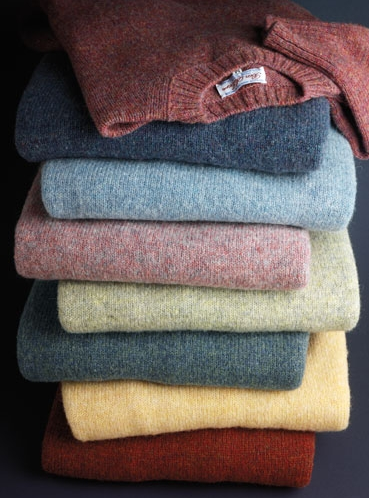
Low- to mid-tier purchases: If your budget is limited, I recommend aiming for sweaters made out of lambswool, Shetland, or merino wools. The first two, all things being equal, are harder-wearing. I also think they can often have more visual depth in their texture and color than most, lower-end merinos, which can be useful if you want to wear the sweater without a jacket. The sweater pictured above really shows off the nice lofty nap on lambswool, I think. 
High-end purchases: If your budget is over $350 or so, consider cashmere. The problem with cashmere below this mark – at least at full retail prices – is that they’re often poorly made. Cashmere is expensive, so when a company is selling a cashmere sweater for under $350 or so, it means they’ve likely skimped on the construction. That can mean shorter fibers used for the yarns, which will result in more breakages and pilling, or thin, loosely knitted fabrics, which will lose their shape over time. Better, I think, to stick to lambswool, Shetlands, and merinos, rather than be tricked into the allure of “cheap” cashmere.
Checking for quality: It’s difficult to determine a sweater’s true quality without having actually owned it for a few years. Nothing can substitute for experience. There are a few things, however, that you can do to make an educated guess. On cashmere, try rubbing the fabric between your fingers for a bit, and see if a light, oily residue has been left on your hands. If there is, that means the fabric was treated with a kind of emulsion, and is probably of low quality. On everything else, see if the sweater has been knitted densely, and check the elasticity of the collars and cuffs. It’s difficult to convey online exactly what level of quality to look for – which is why I think you should browse the inventory at a high-end store – but generally, if you think the sweater might lose its shape easily, it probably will.
Altering knits: Ideally, you should buy something that fits perfectly off-the-rack, but some knits can be altered if you have a good alterationist. On sweaters with side seams, I’ve found it’s easy to take in the body without too much trouble. You can read my post on knit alterations here.
Getting rid of pills: Every sweater, no matter what the quality, will pill to some degree. The question is just how much and how quickly. To take care of pills, I recommend using a sweater shaver. I use this one and it works decently well, though there are probably better ones on the market.
Where to buy: I can’t give a full list of every place that stocks good sweaters, but I can make a few suggestions based off of my experiences. On the high end, I really like Inis Meain, Drumohr, Drake’s, John Smedley, and William Lockie (the last of which you can buy through Heather Wallace). For more affordable purchases, I’ve had good experiences with Brooks Brothers, Club Monaco, and Howard Yount. The first two often do significant mark-downs throughout the season, which is when I think you should buy. Club Monaco also gives students an extra 20% off if they can show a student ID in-store or give a university email address online. I’ve picked up their basic v-neck sweaters before for about $45, and find them to be of a good value. 

Thoughts on Buying Good Sweaters

The best time to purchase sweaters is at the end of the season, when the fall/ winter stock gets discounted by fifty percent or more. The best time to shop for sweaters, however, is now, so that you can give yourself a few months time to figure out what you want and not be rushed into impulse buys come January. So, if you’re out browsing for sweaters, I’d suggest the following:

Low- to mid-tier purchases: If your budget is limited, I recommend aiming for sweaters made out of lambswool, Shetland, or merino wools. The first two, all things being equal, are harder-wearing. I also think they can often have more visual depth in their texture and color than most, lower-end merinos, which can be useful if you want to wear the sweater without a jacket. The sweater pictured above really shows off the nice lofty nap on lambswool, I think. 

High-end purchases: If your budget is over $350 or so, consider cashmere. The problem with cashmere below this mark – at least at full retail prices – is that they’re often poorly made. Cashmere is expensive, so when a company is selling a cashmere sweater for under $350 or so, it means they’ve likely skimped on the construction. That can mean shorter fibers used for the yarns, which will result in more breakages and pilling, or thin, loosely knitted fabrics, which will lose their shape over time. Better, I think, to stick to lambswool, Shetlands, and merinos, rather than be tricked into the allure of “cheap” cashmere.

Checking for quality: It’s difficult to determine a sweater’s true quality without having actually owned it for a few years. Nothing can substitute for experience. There are a few things, however, that you can do to make an educated guess. On cashmere, try rubbing the fabric between your fingers for a bit, and see if a light, oily residue has been left on your hands. If there is, that means the fabric was treated with a kind of emulsion, and is probably of low quality. On everything else, see if the sweater has been knitted densely, and check the elasticity of the collars and cuffs. It’s difficult to convey online exactly what level of quality to look for – which is why I think you should browse the inventory at a high-end store – but generally, if you think the sweater might lose its shape easily, it probably will.

Altering knits: Ideally, you should buy something that fits perfectly off-the-rack, but some knits can be altered if you have a good alterationist. On sweaters with side seams, I’ve found it’s easy to take in the body without too much trouble. You can read my post on knit alterations here.

Getting rid of pills: Every sweater, no matter what the quality, will pill to some degree. The question is just how much and how quickly. To take care of pills, I recommend using a sweater shaver. I use this one and it works decently well, though there are probably better ones on the market.

Where to buy: I can’t give a full list of every place that stocks good sweaters, but I can make a few suggestions based off of my experiences. On the high end, I really like Inis Meain, DrumohrDrake’sJohn Smedley, and William Lockie (the last of which you can buy through Heather Wallace). For more affordable purchases, I’ve had good experiences with Brooks Brothers, Club Monaco, and Howard Yount. The first two often do significant mark-downs throughout the season, which is when I think you should buy. Club Monaco also gives students an extra 20% off if they can show a student ID in-store or give a university email address online. I’ve picked up their basic v-neck sweaters before for about $45, and find them to be of a good value. 

Linen Sweaters

Linen sweaters can be very useful in the fall. They add an extra layer of protection without wearing too warm, making them perfect for days that range from chilly to cool. Cotton sweaters do this as well, of course, but every cotton sweater I’ve owned has lost its shape too easily. The body and sleeves bag after a while, cuffs lose their elasticity, and wrinkles get set into the elbows. Fine for sweatshirts, but less ideal if you want something dressier.  

That leaves linen, which I’ve been wearing on weekends. The Bay Area’s weather has this annoying tendency to not be so chilly in the afternoon that you’d need a sweater, but as soon as nightfall comes, you quickly wish you had one. So I’ve been wearing my linen sweater on days like these, which has kept me comfortable in both the afternoons and evenings.

In addition, I’ve found that linen can add a bit of texture to an otherwise unremarkable ensemble. For example, in the photo above, I have my brown leather jacket, light blue cotton shirt, and grey flannel trousers. Put together, there’s perhaps too much reliance on solid colors, but once you add the rougher texture of a linen sweater, you add a little subtle variation where there needs to be. (Granted, my own pictures don’t show this texture off very well, but the last image, taken from A Suitable Wardrobe, does).

Unfortunately, there aren’t many places that make, or even sell, linen sweaters. The best I know of is Inis Meain. Where you’d think linen can bag over time, Inis Meain’s version holds up just as good as the best merinos and lambswools. You can buy one from A Suitable Wardrobe. In the past, they’ve also manufactured them for Ben Silver and JL Powell, but those retailers are not selling them at the moment. For something more affordable, check Brooks Brothers, Land’s End, and Club Monaco. Those are unfortunately linen-cotton blends, which makes me suspect they won’t hold their shape as well over time, but on the upside, they’re also a fraction of the price. You can also find linen-cotton blend sweaters at Ralph Lauren, though they don’t seem to stock any recommendable ones this season. Ebay may have some from previous years, but you’ll want to avoid the flimsy, loosely knit, baggy variety. A discerning eye and some patience should land you something good. 

Getting a Good Leather Belt
Belts are one of those things you can skimp on without looking too much worse for it. I wrote a post a few months back about how you can find a serviceable (even if not terribly well-made) belt for about $20-30. If you’re willing to spend a little more, however, I thought I’d cover some of my favorite places to get something better.
Ready-to-Wear Belts
If you purchase most of your shoes from one company, it can be wise to source your belt from the same manufacturer. Companies such as Allen Edmonds, Alden, Crockett & Jones, and Edward Green make belts in the same leathers they use for their shoes. In this way, you can easily follow that rule of thumb that the color of one’s belt should generally match one’s shoes.
For other nice, off-the-shelf options, check some of the more traditional American clothiers, such as Ben Silver, Paul Stuart, and Brooks Brothers. Brooks discounts theirs by 25% or more once or twice a season. I liked the buckle on this one so much that I bought three in different colors. And though I don’t personally own any, people have written good reviews of Traflagar and Martin Dingman’s offerings.
Online, you can find some beautiful belts at A Suitable Wardrobe. Their lightly textured hides – made from 20-month old French calves – is a nice balance between the more boring, plain variety (which I admit I mostly have) and showier exotics such as alligator, ostrich, and crocodile. For something more affordable, Austin Jeffers supplies nice, basic designs for about $50. 
Custom Belts
The world of custom belts is vast, but I’ll only cover four. The most affordable I know of is bridle belt maker Narragansett Leathers. Bridle leather is a thickly cut leather with a high oil content, which makes it both harder wearing and water resistant. This is the kind of belting leather that will indeed last a lifetime. Narragansett makes their belts quite simply – leathers are cut, holes are punched, and buckles and keepers are then attached. A basic, durable belt starting at about $35.
Another bridle leather belt maker is Equus Leathers, who I like a bit better for the details they put in. The edges have a nice scored line, the keepers are squared off, and the edge burnishing is done a bit more nicely. I also like their very well-executed handsewn saddle stitching. Charlie, who runs Equus, used to make a living in bespoke saddlery, but the market for that has been destroyed by foreign imports. So now he just does belts, and knows the craft quite well.
The robustness of bridle leather makes it appropriate for chinos and jeans, but for suits and any worsted material, I like dressier, edge stitched belts from companies such as James Reid. Theirs are made from an all-leather, two-piece construction. There’s no inner layer or non-leather filler, which makes them much softer and smarter than bridle leather belts. The backing strap is made from full-grain, oak-tanned, harness quality cowhides from one of the last remaining tanneries in America, Herman Oaks. This strap is beveled along both edges, so that when the top layer is laid down, a contoured cross-sectional shape is produced with a feathered edge. Should you need an affordable buckle to go with their belts, you can contact Charlie at Equus. 
Lastly, there’s Herve N. Sellier, a French maker of fine leather goods that was introduced to me by a friend of mine who knows more about quality clothing than anyone I know. I’ve never tried Herve N. Sellier’s goods, but the company’s founder and craftsman used to produce exclusively for Hermes for twenty years, which alone should probably say something about his craft. Remarkably, the prices he charges for his belts aren’t too much more than those from the options mentioned above.
(Pictured: my belts from James Reid, Narragansett Leathers, and Equus Leathers)

Getting a Good Leather Belt

Belts are one of those things you can skimp on without looking too much worse for it. I wrote a post a few months back about how you can find a serviceable (even if not terribly well-made) belt for about $20-30. If you’re willing to spend a little more, however, I thought I’d cover some of my favorite places to get something better.

Ready-to-Wear Belts

If you purchase most of your shoes from one company, it can be wise to source your belt from the same manufacturer. Companies such as Allen Edmonds, Alden, Crockett & Jones, and Edward Green make belts in the same leathers they use for their shoes. In this way, you can easily follow that rule of thumb that the color of one’s belt should generally match one’s shoes.

For other nice, off-the-shelf options, check some of the more traditional American clothiers, such as Ben Silver, Paul Stuart, and Brooks Brothers. Brooks discounts theirs by 25% or more once or twice a season. I liked the buckle on this one so much that I bought three in different colors. And though I don’t personally own any, people have written good reviews of Traflagar and Martin Dingman’s offerings.

Online, you can find some beautiful belts at A Suitable Wardrobe. Their lightly textured hides – made from 20-month old French calves – is a nice balance between the more boring, plain variety (which I admit I mostly have) and showier exotics such as alligator, ostrich, and crocodile. For something more affordable, Austin Jeffers supplies nice, basic designs for about $50. 

Custom Belts

The world of custom belts is vast, but I’ll only cover four. The most affordable I know of is bridle belt maker Narragansett Leathers. Bridle leather is a thickly cut leather with a high oil content, which makes it both harder wearing and water resistant. This is the kind of belting leather that will indeed last a lifetime. Narragansett makes their belts quite simply – leathers are cut, holes are punched, and buckles and keepers are then attached. A basic, durable belt starting at about $35.

Another bridle leather belt maker is Equus Leathers, who I like a bit better for the details they put in. The edges have a nice scored line, the keepers are squared off, and the edge burnishing is done a bit more nicely. I also like their very well-executed handsewn saddle stitching. Charlie, who runs Equus, used to make a living in bespoke saddlery, but the market for that has been destroyed by foreign imports. So now he just does belts, and knows the craft quite well.

The robustness of bridle leather makes it appropriate for chinos and jeans, but for suits and any worsted material, I like dressier, edge stitched belts from companies such as James Reid. Theirs are made from an all-leather, two-piece construction. There’s no inner layer or non-leather filler, which makes them much softer and smarter than bridle leather belts. The backing strap is made from full-grain, oak-tanned, harness quality cowhides from one of the last remaining tanneries in America, Herman Oaks. This strap is beveled along both edges, so that when the top layer is laid down, a contoured cross-sectional shape is produced with a feathered edge. Should you need an affordable buckle to go with their belts, you can contact Charlie at Equus. 

Lastly, there’s Herve N. Sellier, a French maker of fine leather goods that was introduced to me by a friend of mine who knows more about quality clothing than anyone I know. I’ve never tried Herve N. Sellier’s goods, but the company’s founder and craftsman used to produce exclusively for Hermes for twenty years, which alone should probably say something about his craft. Remarkably, the prices he charges for his belts aren’t too much more than those from the options mentioned above.

(Pictured: my belts from James ReidNarragansett Leathers, and Equus Leathers)

Shawl Collar Cardigans

As legend has it, the original cardigan was invented for Lieutenant General James Brudenell, the Seventh Earl of Cardigan. He wanted a sweater that he could put on without ruining his perfectly coiffed hair. So, the front was cut open, buttons put in, and voilà – we have the cardigan sweater. How the shawl collar – a detail originally designed for the Victorian smoking jacket – got mixed in is unclear. Perhaps it’s because both were considered at-home pieces for lounge and leisure. Who knows.

In any case, shawl collar cardigans make for great autumnal sweaters. The elongated line of the collar nicely frames the face while the body of the knit keeps the wearer comfortable and warm. Today, you can get these from a number of companies, and they range from the stratospherically priced to the reasonably affordable.

I’ll start with the stratospherically priced. Even if we’re not able to afford them, they’re fun to look at (and talk about). These tend to be knitted in Scotland and made from multi-ply wool, cashmere, lambswool, or camelhair yarns. Multi-ply means that multiple plies are twisted together to form a thicker, stronger yarn. This gives the sweater more warmth and durability. The yarns are also usually made from longer animal fibers, which means there are fewer weak points that can break and result in pilling. Finally, the weaves tend to be denser and tighter, which helps ensure that the sweater will keep its shape for years to come. The result, while expensive, is something that’s incredibly chunky, plush, and warm. Wear one of these on a chilly morning and you’ll be immediately be impressed with the quality. 

You can find such cardigans at a number of traditional American clothiers. Ben Silver, O’Connell’s, Kabbaz-Kelly, and Paul Stuart have exceptionally nice ones. From Europe, there’s Drake’s, Berk, Johnstons of Elgin, and Peter Johnston. Ovadia & Sons also makes a nice, thick lambswool one that’s suitable for someone wanting a slimmer fit. All of these tend to be expensive, but some will go on sale at the end of the season. In fact, Ben Silver has some at 50% off now.

For something more affordable, check out J Crew, Rugby, Brooks Brothers, Gant, Land’s End, Orvis, and Save Khaki (one of which is on Gilt). These tend to be thinner than the ones mentioned above, and will likely have cheap, plastic buttons instead of animal horn. You can swap out the buttons yourself, however, for about $30-50. Finally, you may want to consider the options at Northern Watters, White of Hawick, and Black Sheep. I have no personal experience with their products, but nice things have been said about them across the various menswear forums. And although their websites aren’t terribly appealing, it’s important to separate out marketing hype from quality of clothing. They may just be the right middle point between the over-priced, under-delivered “fashion brands,” and the superlative, but incredibly expensive, Scottish knits. 

Shetland Sweaters for Fall

I have mixed feelings about Shetland sweaters. On the one hand, they’re itchy, scratchy, and not the most refined looking of knits. They neither have the softness of cashmere nor the smoothness of merino. On the other hand, that’s what makes them charming. As one member at Ask Andy once unironically (but hilariously), put it, “merino is too ‘metrosexual.’” A rather ridiculous statement, but point taken – these are not fashionable sweaters; they’re frumpy.

But sometimes a little frumpy is good. With a pair of dark green, wide-wale corduroys and reddish-brown shell cordovan tassel loafers, what could be more appropriate than a navy or mid-grey Shetland wool sweater? It has a classic American-trad/ schoolboy charm. To protect yourself from the scratchiness, you can layer it over an oxford cloth button down shirt. Those are the kind that belong underneath these sweaters anyway.

There are a number of places to pick up a Shetland. The best are from O’Connell’s and The Andover Shop. I slightly favor O’Connell’s because it has the more traditional form of a saddle shoulder, but both are top notch in terms of quality. There are other good Scottish ones at Cable Car Clothiers and Ben Silver, as well as an American made Shetland from Bill’s Khakis, which you can read more about at Ivy Style

For something more affordable, consider LL Bean and Brooks Brothers. If you’re an unusual size and need something custom made, try Spirit of Shetland. They’ll knit you a custom Shetland if you tell them the chest size your best fitting sweater. Like with most MTM clothing, I advise erring on the side of fullness rather than slimness. Remember that you can always wear a sweater if it’s slightly full (these are meant to be a bit frumpy anyway), but you’ll never wear a sweater if it’s too tight.

Should you pick one of these up and find that they’re too itchy, consider brushed Shetlands, which have that charming uneven loft that J Press made famous. There are also lambswool sweaters. They look similar to Shetlands in that they’re more textured than merino and harder wearing than cashmere, but they’re not as itchy. You may still need to layer them over a shirt, but at least your loved ones won’t be afraid to hug you. 

Ben Silver Warehouse Sale

Ben Silver just put their warehouse sale online. Ties are available for $67.50, pocket squares for $21.25, and shetland sweaters for $95. Plus a lot more; just take a look

Note, many of the neckties and pocket squares are manufactured by Drake’s, and will say so in the product description if they are. 
Fall and Winter Gloves

Depending on where you live, it may be time to start wearing gloves. When buying a pair, I recommend you avoid cotton, acrylic, and synthetic leathers; they’re neither warm nor durable. Wool or cashmere can work if they’re tightly knit. I wear Filson’s fingerless wool gloves when I go jogging (they also come in a full fingered variety). For people who are always on electronic devices, there’s also Freehands.

For something a bit sharper looking, try leather gloves. These can be made out of any number of animal skins. Peccary is luxurious and soft, while hairsheep is finer and less bulky. Deerskin has a “tacky” surface that’s good for gripping, but it’s a bit more rugged in appearance. There are also hogskin gloves, which are very hard-wearing.

Additionally, there are the linings. If you plan to use these in cold weather, you’ll want the inside of the gloves lined with cashmere or silk. Cashmere will be softer and warmer, but also a bit bulkier. If you’re going to wear them in a cool climate, opt for a pair that’s unlined. They won’t be as warm, but they’ll be more durable and fit better.

Colorwise, black and brown are the most versatile, but like with shoes and suits, I find black to be overrated. I have a few pairs of gloves that match the range of colors in my shoes - merlot, dark brown, mid-brown, and tan. When I want to add a bit of texture or visual interest, I wear dark green capeskin or grey suede lambskin. I also recently ordered some yellow chamois, which are the classic gentleman’s gloves, but they’ve yet to arrive.

As for where you can buy a a good pair, I recommend Dents and Pickett. American retailers such as Ralph Lauren, Brooks Brothers, Paul Stuart, Hickey Freeman, and Ben Silver also sell very good models. The upside to buying from them is that they often hold seasonal sales. For something a bit more affordable, Nordstrom’s house brand is a pretty good value. Finally, remember that the most important part of a glove is the fit - you want something that fits and flatters your hand. If you’re not able to find a proper pair, try getting custom gloves through Chester Jefferies or Madova. Both will make a glove for you if you send in a tracing of your hand, but I find that photocopies or scans work best.

It’s On Sale: Drake’s of London ties

TheSilentist found one of the best sales I’ve ever seen. Ben Silver has a bunch of Drakes ties on sale, with prices as low at $25. There are also the ancient madders that Kiyoshi mentioned below, which are almost certainly Drake’s. I myself grabbed this green twillblue paisley, and tan raw silk, and paid about $42 per tie. Compare that to their retail price at Drakes, which is around $150. 

Note that all Ben Silver ties are around 3.25”. The perfect width for nearly everyone, in my opinion. 

thesilentist:

It’s on sale: Ben Silver neckties — It’s worth taking a gander at the neckties on sale right now at Ben Silver. Granted, I know some of you might not think that ties going for $25-$60 constitutes much of a sale, however, take a closer look at some of the ties offered. Especially the paisley ancient madders. And then hop on over to the Drake’s London site and look at their ancient madders. Notice anything interesting?

After bringing the sale to dieworkwear’s attention, he certainly did. Although it’s not said outright, it definitely appears that Ben Silver is getting at least some of their neckwear from Drake’s London. And they’re putting it on sale for about 20%-33% of the cost.

I originally found them while looking around for a cashmere tie and they have a purple one on sale right now for $45.50. Their tan unlined silk shantung tie is $39. Their ancient madders prints are going for $42 and bowties start at $26.75.

So, that’s when paying $25-$60 for a necktie is a “steal”, because I really doubt you’ll find these prices on (potentially) Drake’s-made ties elsewhere.

(Source: thesilentist)