Brown Suede Shoes for Autumn
While I think brown suede shoes are great for every season (perhaps except winter), they’re particularly fitting for autumn. The soft, warm looking texture fits in well with the season’s mood and looks great against the brown corduroys, gray flannel trousers, and olive moleskins that should be in your standard Fall rotation. 
If you don’t already have a pair, consider getting something nice for this Fall. If you can afford to splurge, I recommend Crockett & Jones’ Belgrave in polo brown calf suede. It’s a pretty expensive shoe, but I think one of the most handsome ones you can buy. For something more affordable,  check out this Charles Tyrwhitt suede chukka (which is on sale right now), Loake’s suede Eton loafer, and Rancourt’s suede camp mocs. For something a bit cheaper than those, there’s Florsheim’s Haviland longwing. I’m not that crazy about Florsheim, but they’re one of the cheapest Goodyear welted shoes on the market. Use the code NewFW11 at checkout and you’ll get 10% off as well as free shipping (thanks to The Silentist for the tip). 
Lastly, it’s not released yet, but the guys at Run of the Mill are coming out with a suede double monkstrap on a Danite sole. The price will be around $450 and it should be released in a month or so. 
(photo credit: NOBD from StyleForum)

Brown Suede Shoes for Autumn

While I think brown suede shoes are great for every season (perhaps except winter), they’re particularly fitting for autumn. The soft, warm looking texture fits in well with the season’s mood and looks great against the brown corduroys, gray flannel trousers, and olive moleskins that should be in your standard Fall rotation. 

If you don’t already have a pair, consider getting something nice for this Fall. If you can afford to splurge, I recommend Crockett & Jones’ Belgrave in polo brown calf suede. It’s a pretty expensive shoe, but I think one of the most handsome ones you can buy. For something more affordable,  check out this Charles Tyrwhitt suede chukka (which is on sale right now), Loake’s suede Eton loafer, and Rancourt’s suede camp mocs. For something a bit cheaper than those, there’s Florsheim’s Haviland longwing. I’m not that crazy about Florsheim, but they’re one of the cheapest Goodyear welted shoes on the market. Use the code NewFW11 at checkout and you’ll get 10% off as well as free shipping (thanks to The Silentist for the tip). 

Lastly, it’s not released yet, but the guys at Run of the Mill are coming out with a suede double monkstrap on a Danite sole. The price will be around $450 and it should be released in a month or so. 

(photo credit: NOBD from StyleForum)

Put This On Episode 6: Clothing Credits

Intro:

Blazer - Brooks Brothers (Vintage)

Pants - Ralph Lauren Purple Label (Vintage)

Shirt - Brooks Brothers Black Fleece

Tie - Saks Fifth Avenue

Vest - Brooks Brothers Black Fleece

Shoes - Florsheim (Vintage)

At CEGO

Shirt One - Lands’ End

Shirt Two - CEGO Custom Shirtmakers

Pants - Woolrich Woolen Mills

Tie - Vintage (Unlabeled)

Belt - Narragansett Leathers

At Alan Flusser Custom

Suit - Brooks Brothers

Shirt - Brooks Brothers Black Fleece

Tie - Carrol & Co. (Vintage)

Sweater - Shetland Hand Knits

At Pro Tailor

Blazer - Kiton (Vintage)

Pants - Brooks Brothers Black Fleece

Shirt - Corneliani

Tie - Luciano Barbera (Vintage)

Shoes - Brooks Brothers (Vintage)

Q and Answer: What Color Shoes Should I Wear With a Navy Suit?
Peter writes: I was recently given a fantastic vintage navy blue suit from the ’70s by my father. The  only thing stopping me from wearing it every opportunity I have is the  fact that I do not know what shoes to wear with it. I have seen images  of men wearing brown and black oxfords and derbys and I really have no  idea what is correct. Also, how does the choice of shoe alter which sock  is appropriate?
What color shoes to wear with a navy suit is a matter of perpetual debate. The general answer is that it depends on the circumstances and personal preference. The specific answer? Well, let’s run it down.
Brown: Once, wearing brown shoes with navy was heresy unless you were a Boston Brahmin or a particularly wild Italian. However, brown is the default choice for daytime wear today. The color makes a comfortable partner for navy blue, particularly in darker hues like chocolate. Whether brown shoes are appropriate in the workplace is up to you; there are traditional gentlemen in London who still think brown shoes are inappropriate at a business no matter what color your suit is.
Black: This is the traditional choice, particularly in the English tradition. Black shoes are more suitable for business and the evening, and while I don’t go to a lot of suit-wearing business meetings, when I wear a navy suit at night, I reach for the sharper, more formal black footwear. 
Burgundy: Burgundy or cordovan shoes are the wild card here. (Note that “cordovan” is a color, “shell cordovan” a material.) They pair well with navy and are suitable for day or night wear. They’re certainly a somewhat bolder choice than chocolate brown or black, but I think they acquit themselves well. When I wear a navy suit during the day, I find myself pulling out my burgundy shell cordovan Florsheim longwings.
As far as socks are concerned, your default should be to match your trousers - that means navy socks. This applies no matter what color shoes you’re wearing. In fact, you can pretty much wear navy socks with anything other than shorts. If you don’t choose navy, you’ll want something with some contrast, and that contrast should compliment the rest of your outfit. It can pull a color from your accessories, for example. It can also be a wildcard - once in a while, with a white square, blue shirt, blue tie and blue suit, I’ll wear red socks.
(By the way: while this guy looks good, I don’t recommended fitting a suit like this.)

Q and Answer: What Color Shoes Should I Wear With a Navy Suit?

Peter writes: I was recently given a fantastic vintage navy blue suit from the ’70s by my father. The only thing stopping me from wearing it every opportunity I have is the fact that I do not know what shoes to wear with it. I have seen images of men wearing brown and black oxfords and derbys and I really have no idea what is correct. Also, how does the choice of shoe alter which sock is appropriate?

What color shoes to wear with a navy suit is a matter of perpetual debate. The general answer is that it depends on the circumstances and personal preference. The specific answer? Well, let’s run it down.

  • Brown: Once, wearing brown shoes with navy was heresy unless you were a Boston Brahmin or a particularly wild Italian. However, brown is the default choice for daytime wear today. The color makes a comfortable partner for navy blue, particularly in darker hues like chocolate. Whether brown shoes are appropriate in the workplace is up to you; there are traditional gentlemen in London who still think brown shoes are inappropriate at a business no matter what color your suit is.
  • Black: This is the traditional choice, particularly in the English tradition. Black shoes are more suitable for business and the evening, and while I don’t go to a lot of suit-wearing business meetings, when I wear a navy suit at night, I reach for the sharper, more formal black footwear. 
  • Burgundy: Burgundy or cordovan shoes are the wild card here. (Note that “cordovan” is a color, “shell cordovan” a material.) They pair well with navy and are suitable for day or night wear. They’re certainly a somewhat bolder choice than chocolate brown or black, but I think they acquit themselves well. When I wear a navy suit during the day, I find myself pulling out my burgundy shell cordovan Florsheim longwings.

As far as socks are concerned, your default should be to match your trousers - that means navy socks. This applies no matter what color shoes you’re wearing. In fact, you can pretty much wear navy socks with anything other than shorts. If you don’t choose navy, you’ll want something with some contrast, and that contrast should compliment the rest of your outfit. It can pull a color from your accessories, for example. It can also be a wildcard - once in a while, with a white square, blue shirt, blue tie and blue suit, I’ll wear red socks.

(By the way: while this guy looks good, I don’t recommended fitting a suit like this.)

Put This On Episode 5: Clothing Credits

Intro:
Tie: Pierrepont Hicks
Shirt: Lands’ End
Sweater: Vintage Scottish Cashmere
Jeans: Levis LVC 1947
Shoes: Grenson
Vest: Lands’ End

At J. Press:
Shirt: CEGO Custom Shirtmaker
Jacket: Polo Ralph Lauren
Sweater: Vintage Scottish Cashmere
Tie: Vintage Unlabeled
Pocket Square: Luciano Barbera
Pants: Incotex

At Thom Browne:
Shirt: Brooks Brothers Black Fleece
Tie: Santoni
Pocket Square: Vintage
Pants: Vintage Ralph Lauren Purple Label
Shoes: Vintage Florsheim
Socks: Robert Talbott

Put This On Episode 4: Clothing Credits

At Larchmont Barbershop

Jacket - A. Di Nella & Son of Philadelphia (Vintage)

Shirt - Luciano Barbera

Tie - Courtesy of Berg & Berg

Pants - Brunello Cucinelli

Pocket Square - Etro

The Wet Shave

Pajamas - Brooks Brothers

Robe - Holliday & Brown for Prada

In the Closet

Blazer - Chester Barrie

Shirt - CEGO Custom Shirtmakers

Pants - Brunello Cucinelli

Shoes - Vintage Florsheim

Tie - Vintage Bullock & Jones

Pocket Square - Courtesy of Kent Wang

Breaking: Tim Duncan Announces Shoe Deal With Florsheim
An anonymous emailer brought these lovely longwings to my attention. They’re from a new venture by Florsheim called Florsheim Limited; the model is the Veblen. They’re Goodyear welted and unlike Florsheim’s regular longwings, they’re made with full-grain leather, not corrected grain. The particularly nice bit is that they’re only $160. They’re made in India, so don’t expect the world’s finest craftsmen to be working on these, but on paper they look like a superb value. They’re available from Endless and Zappos among other places, so you should be able to find a coupon to bring the price down even further.  Well done, Florsheim!

An anonymous emailer brought these lovely longwings to my attention. They’re from a new venture by Florsheim called Florsheim Limited; the model is the Veblen. They’re Goodyear welted and unlike Florsheim’s regular longwings, they’re made with full-grain leather, not corrected grain. The particularly nice bit is that they’re only $160. They’re made in India, so don’t expect the world’s finest craftsmen to be working on these, but on paper they look like a superb value. They’re available from Endless and Zappos among other places, so you should be able to find a coupon to bring the price down even further.  Well done, Florsheim!

It’s On eBay

Vintage Florsheim Imperial Pebble Grain Longwings

Found these today, and they’re a bit big for me.  If you’re a 13N, these will last you a lifetime.

Start at $49.99, end Sunday (Buy it now $99)

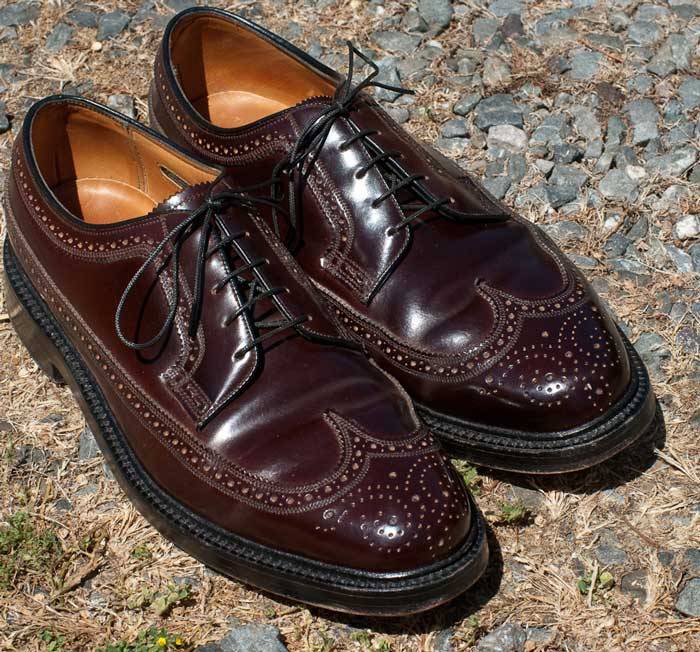
Just in time for my complaints about the declining quality of the middle level of shoes, a StyleForum user called CasmirRadon finds these shell cordovan Florsheim Imperial longwings at Goodwill for $2.  They’re his size, too.  Dag.

Just in time for my complaints about the declining quality of the middle level of shoes, a StyleForum user called CasmirRadon finds these shell cordovan Florsheim Imperial longwings at Goodwill for $2.  They’re his size, too.  Dag.
Leather: A Cautionary Tale
I’ve been thinking about shoes, as we prepare to shoot the first episode of season one, which is about caring for your footwear.  Judging by your questions, there are lots of PTO readers who want some basic information about choosing quality shoes.  Today, let’s talk a bit about leather.
First of all: don’t buy dress shoes that aren’t made of leather. Perhaps that’s obvious, but I will say it anyway, just in case.  I understand that some folks are vegetarian or vegan, and don’t wear leather, and I respect that completely.  All I can suggest to those people is maybe to consider whether their ethics will accommodate used leather shoes.  Men’s dress shoes are made of leather because leather is a fantastic material to make shoes from, and plastic is not.
That said, just because you’ve bought some leather shoes doesn’t mean you’re getting the good stuff.
If you walk into the men’s shoe section of JC Penney’s today, you’ll generally find shoes made of leather.  But not the good stuff.  Like the Kenneth Cole shoes pictured above, they’re made of what’s called “corrected grain” or sometimes “polished” leather.
What is corrected grain leather?  Well, most animal hides are imperfect.  They have marks, scars, imperfections that make them unsuitable for use in shoes.  You wouldn’t, after all, buy a shoe with a big scar on it.  There are plenty of applications for leather which don’t require a perfect surface, but shoes do.  So rather than use only the best portions of the hide for shoemaking, manufacturers literally sand off the surface of the hide.  Then they build a new, chemical surface on top.
The result looks like the (hideous) Kenneth Coles pictured above.  It’s leather, but the finish is, for lack of a better adjective, plastic-y.  It has an unnatural shine, and there is either no grain or, sometimes, an embossed grain.  Like when people make fake alligator handbags.
This works out fine for the cheap manufacturer, as the shoe looks good in the store to a consumer who’s just looking for “shiny leather,” but the disadvantages are numerous.  Besides the tacky finish, corrected grain creases more severely (because of the added layer of plastic-y chemicals on top of the leather), breathes more poorly, and ages badly, as the finish can be damaged or can even flake off of the leather below.  If you go to a thrift store, you’ll find many cheap Bostonian dress shoes with a finish that’s literally peeling off the shoe.  So, in short, avoid corrected grain.
Instead, look for shoes made of full-grain leather.  Spend some time looking at a quality shoe in a nice department store - say an Alden shoe in Nordstrom.  Notice that the surface feels like leather, not like enamel.  Notice the depth of the color.  It’s not too tough to tell the difference between full grain and corrected grain if you get a little practice under your belt.  Generally quality manufacturers are (justifiably) proud of the materials they use - a good shoe salesperson will be familiar with the difference.  Language like “full-grain calf” is what you’re looking for, and “polished calf” is what you’re trying to avoid.  A well-made pair of full-grain leather shoes will last through half a dozen resolings and twenty years of wear.
There’s one more type of shoe leather you should be aware of: shell cordovan. Unlike most shoe leather, made from cow hides, shell cordovan is made from horse hides.  Specifically from the thickest part of the horse hide, the rump.  Shell cordovan shoes are expensive, because relatively few horse hides are processed for shoe leather, but they have several advantages over calf.  Shell cordovan is relatively thick and extremely durable.  It’s more weather-resistant than calf.  It also doesn’t crease in the way calf does.  The stress points in shell cordovan shoes don’t look like a little network of rivers, but rather like a few rolling hills.  Of course, the scarcity and quality of shell means that new shell cordovan shoes tend to sell for upwards of $500.
Because shell cordovan shoes last so well, they’re possible to find used.  Manufacturers like Florsheim, Nettleton and Alden used them for traditional shoes for many years.  You’d do well to look at some pictures of worn shell cordovan shoes so you can recognize the material should you run across it in a thrift store.
Leather is the essential building block of every shoe.    If you want footwear that can live with you for the next twenty years, get the good stuff.

Leather: A Cautionary Tale

I’ve been thinking about shoes, as we prepare to shoot the first episode of season one, which is about caring for your footwear.  Judging by your questions, there are lots of PTO readers who want some basic information about choosing quality shoes.  Today, let’s talk a bit about leather.

First of all: don’t buy dress shoes that aren’t made of leather. Perhaps that’s obvious, but I will say it anyway, just in case.  I understand that some folks are vegetarian or vegan, and don’t wear leather, and I respect that completely.  All I can suggest to those people is maybe to consider whether their ethics will accommodate used leather shoes.  Men’s dress shoes are made of leather because leather is a fantastic material to make shoes from, and plastic is not.

That said, just because you’ve bought some leather shoes doesn’t mean you’re getting the good stuff.

If you walk into the men’s shoe section of JC Penney’s today, you’ll generally find shoes made of leather.  But not the good stuff.  Like the Kenneth Cole shoes pictured above, they’re made of what’s called “corrected grain” or sometimes “polished” leather.

What is corrected grain leather?  Well, most animal hides are imperfect.  They have marks, scars, imperfections that make them unsuitable for use in shoes.  You wouldn’t, after all, buy a shoe with a big scar on it.  There are plenty of applications for leather which don’t require a perfect surface, but shoes do.  So rather than use only the best portions of the hide for shoemaking, manufacturers literally sand off the surface of the hide.  Then they build a new, chemical surface on top.

The result looks like the (hideous) Kenneth Coles pictured above.  It’s leather, but the finish is, for lack of a better adjective, plastic-y.  It has an unnatural shine, and there is either no grain or, sometimes, an embossed grain.  Like when people make fake alligator handbags.

This works out fine for the cheap manufacturer, as the shoe looks good in the store to a consumer who’s just looking for “shiny leather,” but the disadvantages are numerous.  Besides the tacky finish, corrected grain creases more severely (because of the added layer of plastic-y chemicals on top of the leather), breathes more poorly, and ages badly, as the finish can be damaged or can even flake off of the leather below.  If you go to a thrift store, you’ll find many cheap Bostonian dress shoes with a finish that’s literally peeling off the shoe.  So, in short, avoid corrected grain.

Instead, look for shoes made of full-grain leather.  Spend some time looking at a quality shoe in a nice department store - say an Alden shoe in Nordstrom.  Notice that the surface feels like leather, not like enamel.  Notice the depth of the color.  It’s not too tough to tell the difference between full grain and corrected grain if you get a little practice under your belt.  Generally quality manufacturers are (justifiably) proud of the materials they use - a good shoe salesperson will be familiar with the difference.  Language like “full-grain calf” is what you’re looking for, and “polished calf” is what you’re trying to avoid.  A well-made pair of full-grain leather shoes will last through half a dozen resolings and twenty years of wear.

There’s one more type of shoe leather you should be aware of: shell cordovan. Unlike most shoe leather, made from cow hides, shell cordovan is made from horse hides.  Specifically from the thickest part of the horse hide, the rump.  Shell cordovan shoes are expensive, because relatively few horse hides are processed for shoe leather, but they have several advantages over calf.  Shell cordovan is relatively thick and extremely durable.  It’s more weather-resistant than calf.  It also doesn’t crease in the way calf does.  The stress points in shell cordovan shoes don’t look like a little network of rivers, but rather like a few rolling hills.  Of course, the scarcity and quality of shell means that new shell cordovan shoes tend to sell for upwards of $500.

Because shell cordovan shoes last so well, they’re possible to find used.  Manufacturers like Florsheim, Nettleton and Alden used them for traditional shoes for many years.  You’d do well to look at some pictures of worn shell cordovan shoes so you can recognize the material should you run across it in a thrift store.

Leather is the essential building block of every shoe.    If you want footwear that can live with you for the next twenty years, get the good stuff.