Should You Take a Bath in Your Jeans and Other Common Denim Questions
Denim Lore with Kiya Babzani, Part II
Yesterday, we talked with Kiya Babzani - co-owner and founder of Self Edge - about whether or not people should really wait six months before washing their jeans. Today, we’ll explore three other common beliefs in the denim community, including the one about taking a bath in your jeans when you first bring them home. 
Derek Guy: It’s commonly advised that jeans should always fit extremely tight when you first buy them – to the point where you can barely button them up. Is that true?
Kiya Babzani: Definitely not. There are two deciding factors when buying jeans: does it look good and does it feel good? If you’re stuffing yourself into a pair of jeans two sizes too small because that’s what the blogs and message boards tell you, you’re doing it wrong.
DG: Isn’t the idea that some jeans will heavily stretch over time?
KB: If you’re a 32 and you buy a pair of jeans in a size 30 to account for stretching, you’re going to look like a stuffed sausage and have red slashes at your hips for weeks. That’s neither comfortable nor attractive. Also, most decent jeans don’t stretch that much with wear. The maximum is about 1.5” or so unless you get them extremely tight when new.
DG: How about the idea that you should first wear your jeans in the bathtub while letting them soak?
KB: People like to overcomplicate the wearing of jeans. The idea that you should wear your jeans in a bathtub is a terrible idea. It’s not only uncomfortable, but it stretches out the jeans in unnatural ways. It creates knee-bagging and pulls at the hips, giving you hip-flare.
It’s true, however, that you should always soak unsanforized denim before wearing (you don’t need to for sanforized denim). If you’re buying them from a store, you should find the fit you like then buy one size up and do a 30-minute hot water soak once you bring them home. If you’re buying online, just buy one size/measurement up from your true size.
You need to soak unsanforized denim so that the shrinkage is gone before you start the fading process. The jeans will also last far longer if soaked before wearing. You don’t need to do it while wearing them in the tub, however. Again, this will just create unnatural stretching in areas such as the knees and hips. Just throw them in a tub, sink, or bucket, and let them soak. 
DG: OK, let’s do one last bit of denim lore. I’ve read that raw denim will mold to your body. Is this actually true?
KB: Yes, all raw denim will mold to your body, but sanforized denim only slightly molds, while unsanforized denim will take on the shape of your figure. If you take two pairs of jeans in the same fit and size, one sanforized and one unsanforized, soak them both in water for five minutes, put them on, and let them dry (not something I recommend doing, by the way, for the reasons mentioned above). This will quicken the process of “molding.” Afterwards, you can take the jeans off and lay them down. You’ll then notice that the sanforized pair will be nearly like they were before, while the unsanforized pair will look like you’re still wearing them.
DG: Thanks for taking the time to speak with us, Kiya
KB: Thank you.
(Photo credit: Farhad Samari)

Should You Take a Bath in Your Jeans and Other Common Denim Questions

Denim Lore with Kiya Babzani, Part II

Yesterday, we talked with Kiya Babzani - co-owner and founder of Self Edge - about whether or not people should really wait six months before washing their jeans. Today, we’ll explore three other common beliefs in the denim community, including the one about taking a bath in your jeans when you first bring them home. 

Derek Guy: It’s commonly advised that jeans should always fit extremely tight when you first buy them – to the point where you can barely button them up. Is that true?

Kiya Babzani: Definitely not. There are two deciding factors when buying jeans: does it look good and does it feel good? If you’re stuffing yourself into a pair of jeans two sizes too small because that’s what the blogs and message boards tell you, you’re doing it wrong.

DG: Isn’t the idea that some jeans will heavily stretch over time?

KB: If you’re a 32 and you buy a pair of jeans in a size 30 to account for stretching, you’re going to look like a stuffed sausage and have red slashes at your hips for weeks. That’s neither comfortable nor attractive. Also, most decent jeans don’t stretch that much with wear. The maximum is about 1.5” or so unless you get them extremely tight when new.

DG: How about the idea that you should first wear your jeans in the bathtub while letting them soak?

KB: People like to overcomplicate the wearing of jeans. The idea that you should wear your jeans in a bathtub is a terrible idea. It’s not only uncomfortable, but it stretches out the jeans in unnatural ways. It creates knee-bagging and pulls at the hips, giving you hip-flare.

It’s true, however, that you should always soak unsanforized denim before wearing (you don’t need to for sanforized denim). If you’re buying them from a store, you should find the fit you like then buy one size up and do a 30-minute hot water soak once you bring them home. If you’re buying online, just buy one size/measurement up from your true size.

You need to soak unsanforized denim so that the shrinkage is gone before you start the fading process. The jeans will also last far longer if soaked before wearing. You don’t need to do it while wearing them in the tub, however. Again, this will just create unnatural stretching in areas such as the knees and hips. Just throw them in a tub, sink, or bucket, and let them soak. 

DG: OK, let’s do one last bit of denim lore. I’ve read that raw denim will mold to your body. Is this actually true?

KB: Yes, all raw denim will mold to your body, but sanforized denim only slightly molds, while unsanforized denim will take on the shape of your figure. If you take two pairs of jeans in the same fit and size, one sanforized and one unsanforized, soak them both in water for five minutes, put them on, and let them dry (not something I recommend doing, by the way, for the reasons mentioned above). This will quicken the process of “molding.” Afterwards, you can take the jeans off and lay them down. You’ll then notice that the sanforized pair will be nearly like they were before, while the unsanforized pair will look like you’re still wearing them.

DG: Thanks for taking the time to speak with us, Kiya

KB: Thank you.

(Photo credit: Farhad Samari)

Should I Really Wait Six Months To Wash My Jeans?
Denim Lore with Kiya Bazani, Part One
Jesse’s excerpt from Marc Maron’s hilarious NYT article yesterday coincidentally comes just a day before I finished my interview with Kiya Babzani. As Marc’s article alludes to, there are some seemingly strange beliefs today on how to get the perfect pair of jeans: wear them in the bathtub when you first get them home, don’t wash them for six months, stick them in the oven (!) or freezer if they start to stink, run around in the ocean with them on, etc. 
I asked Kiya if he could talk with us to see if some of these things are true. Kiya is the co-owner and founder of Self Edge, a very popular shop for jeans with locations in Los Angeles, San Francisco, and New York. On menswear forums, he’s commonly considered an expert on denim, so I thought he’d be a great person to talk to about denim lore. 
Derek Guy: Let’s start with the most popular piece of advice: that one should not wash their jeans for at least the first six months of them being worn. Is this true?
Kiya Babzani: To my knowledge, that’s something that was started by APC and/or Nudies. There are a couple of reasons why someone would recommend that you shouldn’t wash your jeans. First, people getting into raw selvedge denim are usually looking for a certain type of look – one that has high contrast fades with dramatically defined lines around the top of the lap and behind the knees. This kind of fading is difficult to achieve with denim that has been done to death, which is what most brands use.
DG: Can you explain what do you mean by “done to death?”
KB: I mean fabric that has been singed, mercerized, calendered, and sanforized. They’ve taken every bit of life out of the fabric, leaving something very smooth and even. With denim treated like this – yes, you’ll normally need infrequent washings to get a very high-contrast fade at the end. But what most people don’t talk about is how if you buy a pair of jeans made from unsanforized denim, you’ll get these kinds of fades even if you washed your jeans every two weeks.  
With unsanforized loomstate denim, the fabric is rigid and creases set in far faster. Additionally, due to the micro-hairs on the fabric (which are sometimes visible), the denim is more abrasive, which will allow you to get that very defined, high contrast look naturally, even with frequent washings.
DG: So denim that has been heavily treated – singed, mercerized, sanforized, etc. – will need longer periods of not being washed in order to get those high contrast fades, but unsanforized loomstate denim can achieve that with regular washings (every two weeks or so)?
KB: Yes, but add to this the fact that washing your jeans regularly is the sanitary thing to do, and doing so will make your jeans last longer. Cotton fibers become brittle with time and they need to be routinely “moisturized” (for lack of a better word). The longer you go without washing, the more prone your jeans are to crotch blowouts and “punch holes” behind the knees.
In the end, however, you never get fades on sanforized denim that are as interesting as you would on unsanforized denim. Of course, this is all very subjective, but in my opinion, unsanforized denim will always develop a more beautiful and interesting look.
DG: What about denim that has just been sanforized, but nothing else?
KB: Sanforization is the leading cause of what I explained above, with everything else being a minor addition.
[Check back tomorrow for part two of our interview with Kiya]
(Photo credit: Farhad Samari)

Should I Really Wait Six Months To Wash My Jeans?

Denim Lore with Kiya Bazani, Part One

Jesse’s excerpt from Marc Maron’s hilarious NYT article yesterday coincidentally comes just a day before I finished my interview with Kiya Babzani. As Marc’s article alludes to, there are some seemingly strange beliefs today on how to get the perfect pair of jeans: wear them in the bathtub when you first get them home, don’t wash them for six months, stick them in the oven (!) or freezer if they start to stink, run around in the ocean with them on, etc. 

I asked Kiya if he could talk with us to see if some of these things are true. Kiya is the co-owner and founder of Self Edge, a very popular shop for jeans with locations in Los Angeles, San Francisco, and New York. On menswear forums, he’s commonly considered an expert on denim, so I thought he’d be a great person to talk to about denim lore. 

Derek Guy: Let’s start with the most popular piece of advice: that one should not wash their jeans for at least the first six months of them being worn. Is this true?

Kiya Babzani: To my knowledge, that’s something that was started by APC and/or Nudies. There are a couple of reasons why someone would recommend that you shouldn’t wash your jeans. First, people getting into raw selvedge denim are usually looking for a certain type of look – one that has high contrast fades with dramatically defined lines around the top of the lap and behind the knees. This kind of fading is difficult to achieve with denim that has been done to death, which is what most brands use.

DG: Can you explain what do you mean by “done to death?”

KB: I mean fabric that has been singed, mercerized, calendered, and sanforized. They’ve taken every bit of life out of the fabric, leaving something very smooth and even. With denim treated like this – yes, you’ll normally need infrequent washings to get a very high-contrast fade at the end. But what most people don’t talk about is how if you buy a pair of jeans made from unsanforized denim, you’ll get these kinds of fades even if you washed your jeans every two weeks.  

With unsanforized loomstate denim, the fabric is rigid and creases set in far faster. Additionally, due to the micro-hairs on the fabric (which are sometimes visible), the denim is more abrasive, which will allow you to get that very defined, high contrast look naturally, even with frequent washings.

DG: So denim that has been heavily treated – singed, mercerized, sanforized, etc. – will need longer periods of not being washed in order to get those high contrast fades, but unsanforized loomstate denim can achieve that with regular washings (every two weeks or so)?

KB: Yes, but add to this the fact that washing your jeans regularly is the sanitary thing to do, and doing so will make your jeans last longer. Cotton fibers become brittle with time and they need to be routinely “moisturized” (for lack of a better word). The longer you go without washing, the more prone your jeans are to crotch blowouts and “punch holes” behind the knees.

In the end, however, you never get fades on sanforized denim that are as interesting as you would on unsanforized denim. Of course, this is all very subjective, but in my opinion, unsanforized denim will always develop a more beautiful and interesting look.

DG: What about denim that has just been sanforized, but nothing else?

KB: Sanforization is the leading cause of what I explained above, with everything else being a minor addition.

[Check back tomorrow for part two of our interview with Kiya]

(Photo credit: Farhad Samari)

My Recommendation for Jeans: 3sixteens

APCs tend to be the standard recommendation for people looking to get their first pair of quality jeans. In my experience, there are disadvantages to the old standard. They stretch out much more than other jeans, have poor stitching, and aren’t built from Japanese denim. I recently had a great conversation with Kiya Babzani, co-owner of Self Edge, one of the leading denim shops in the world, about why APCs have become so popular, despite their mediocre quality.

“APCs got into the scene really early and offered a raw selvedge jean with nothing on the back pockets at a good price,” Kiya explained. “There are other brands but most of [them] have a very Americana look to their branding. APCs were a crossroads between fashion and classic […] a more simple, almost ‘fashion,’ look as opposed to a straight reproduction vintage style look which was originally designed for workwear.”

Nowadays, however, we have more options in the sub-$200 price point, and for such buys, I think 3sixteen’s jeans are the best that you can get. Unlike APCs, they’re actually made from Japanese denim (specifically a 14.5 oz red-line selvedge denim woven at Kuroki Mills). 

“The Japanese have mastered the art of producing denim, and textiles in general,” Kiya said. “Their textile producing techniques date back further than most of the world, as they produced extremely complex (even for today) fabrics for kimonos, which were dyed with the most exotic dyes and woven on wooden looms.”

What’s so special about 3sixteen’s particular Japanese denim? For one, it’s woven exclusively for them, which is rare for a company that isn’t the size of Levis or Gap. The material is pure indigo dyed, with no sulfur, which gives the jeans a deeper blue color than many other models you’ll find on the market. At the same time, there is minimal processing, which allows the denim to retain some hairiness and prevents it from looking too sleek or uniform. They also have an interesting weave. The 14.5oz weight gives the jeans some heft, but the open ended weft yarns leave the jeans fairly soft on the inside. In short, the denim is some of the most handsome I’ve seen and comfortable I’ve worn. 

The best thing about the jeans, however, is the fit. While the company makes a slim tapered model (ST-100x), I favor the straight legged (SL-100x). They have a respectable rise and a flattering fit all around. If you like the fit of slim, but not skinny, trousers, you’ll probably like the fit of the SL-100x. 

You can get a pair from Self Edge for $195. They’ll hem your jeans with a traditional chainstitch for free, which will give you a roping effect as your jeans age.  That’s still a bit pricey for many people, to be sure, but if you’re looking to get some quality jeans, I can’t think of a better first buy. 

Q & A: Where to Shop For Men’s Clothes in San Francisco?
Chris writes from Germany: Next month, I’ll be in California for vacation and would like to get some recommendations for stores and boutiques in San Francisco that sell unique and classy clothes like the ones you cover in your blog.  I would be thrilled if you guys could offer some suggestions.
It just so happens that I’m a native of the ‘Sco, and I’d be happy to help you out.  San Francisco’s one of the best shopping cities in the world, and there are a wealth of choices.
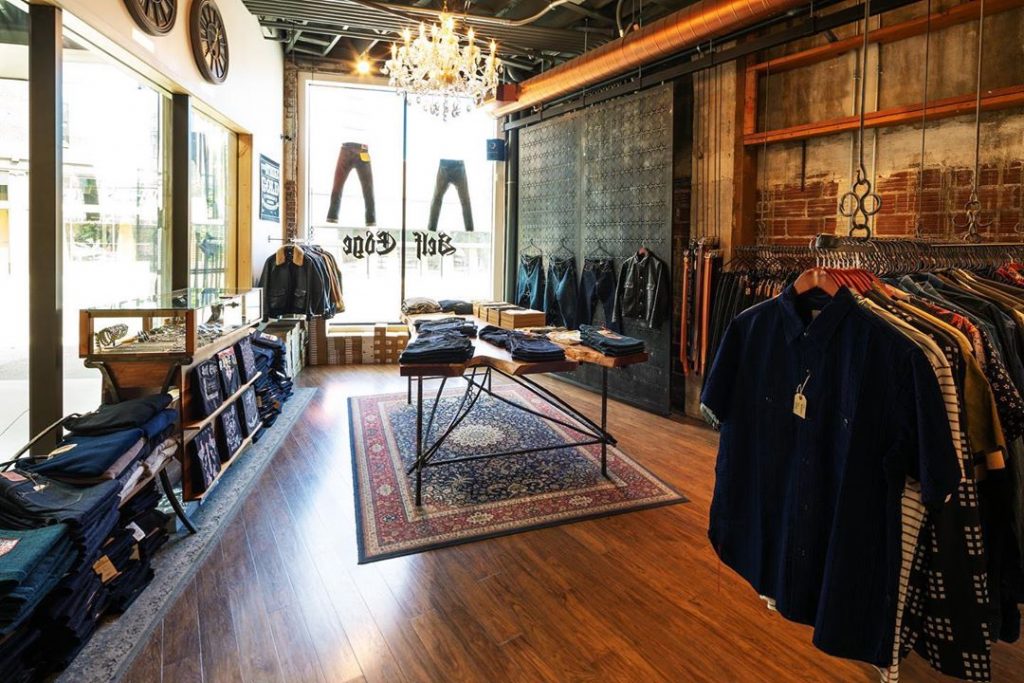
Let’s start with new casual clothes.  The denim-only store Self Edge opened its first outlet in San Francisco some years ago.  If you’re interested in jeans, it’s probably the best store in the world.  Be aware, though, that you’ll be spending a few hundred bucks.
MAC, which stands for Modern Appealing Clothing, is probably the best store in the city for contemporary designer casual clothes.  If you’re the kind of guy who buys Maison Martin Margiela or Rick Owens, it’s a must-visit - you can find in Hayes Valley, a couple of blocks from City Hall.  Even if you’re not the designer type, it’s worth browsing.  Prices are, as you might expect, quite high.  Saks Fifth Avenue and Barney’s, both of which are off Union Square, are also great sources for that sort of thing.  Also worth checking out is Unionmade, which opened quite recently and offers authentic and “authentic” clothing for people who are really into, you know, craft and heritage and that kind of stuff.
If you’re looking for something a bit classier, there are options there, as well.  The classic is the men’s clothier Wilkes Bashford.  The owner, Wilkes, was forced to sell a year or two ago, but it was to sympathetic buyers, and he remains at the head of the operation.  It’s as luxurious a menswear store as exists in the world.  Wilkes is good friends with the former mayor (and famous dandy) Willie Brown Jr., and has outfitted him for many years.  Wilkes is, again, downtown near Union Square.
A little further downtown, you can find Cable Car Clothiers, one of the last true traditional menswear stores on the West Coast.  If you’re looking for a Sherlock Holmes hat, sold without irony, this is the place to visit.  They also sell British-made umbrellas and American-made suits and everything else that was as classic in 1945 as it was in 1965 as it was in 1985 as it is today.  Again, you won’t save money shopping here, but it’s a truly magical place.  It’s also not too far from the Alden Store, on Sutter, where they can show you the full line of Alden shoes for men.
If you’re interested in spending a little less, there are a lot of options there, as well.  I’m fond of many thrift stores in San Francisco, but I’m a little hesitant to blow up my spots.  I’ll say that the Town School Clothes Closet is full of wonderful things which are a bit overpriced, but prices come down during regular sales.  I’ve always enjoyed thrifting in the Mission, where I grew up, but if you head to the Fillmore, you’ll find more treasures.  That’s where rich people live, you see.  If you really want to get crazy, check out the Goodwill As-Is Store, South of Market, where you can literally fight people as you go through piles of clothes on long, narrow tables in what amounts to a dungeon of savings.
There’s plenty of vintage in San Francisco, as well.  I’ve been a customer at Clothes Contact, on Valencia at 16th, since they opened… 20 years ago, maybe?  I remember buying a bandleader jacket there because I thought it made me look like Michael Jackson.  (While you’re in the Mission, say hi to my friends Lan and Lino at the amazing vintage furniture and housewares store The Apartment).  La Rosa is the best of the vintage stores on Haight Street, and it’s also right nearby Amoeba Records.
It’s tough to find good men’s consignment, but Goodbyes does it better than any other store I’ve run across.  Quality goods, reasonable prices, and sometimes even helpful sales staff.  (One lady is super-mean, but mostly they’re very nice.)  You can also check out Jeremy’s, which has a stock that’s split between store liquidations and consignments.  A little pricier and often a little lower-quality, but also a little less fussy.
Hopefully that’s enough to fill your time.  
If I might offer some unsolicited tourist advice: many San Francisco tourist traps are great.  Cable cars, for example, are still cool to me.  Riding a bike in Golden Gate Park is wonderful.  Alcatraz is pretty neat, too.  Fisherman’s Wharf, though, is fucking awful.  Don’t go there.  If you do, skip everything except The Musee Mechanique, at Pier 45.

Q & A: Where to Shop For Men’s Clothes in San Francisco?

Chris writes from Germany: Next month, I’ll be in California for vacation and would like to get some recommendations for stores and boutiques in San Francisco that sell unique and classy clothes like the ones you cover in your blog.  I would be thrilled if you guys could offer some suggestions.

It just so happens that I’m a native of the ‘Sco, and I’d be happy to help you out.  San Francisco’s one of the best shopping cities in the world, and there are a wealth of choices.

Let’s start with new casual clothes.  The denim-only store Self Edge opened its first outlet in San Francisco some years ago.  If you’re interested in jeans, it’s probably the best store in the world.  Be aware, though, that you’ll be spending a few hundred bucks.

MAC, which stands for Modern Appealing Clothing, is probably the best store in the city for contemporary designer casual clothes.  If you’re the kind of guy who buys Maison Martin Margiela or Rick Owens, it’s a must-visit - you can find in Hayes Valley, a couple of blocks from City Hall.  Even if you’re not the designer type, it’s worth browsing.  Prices are, as you might expect, quite high.  Saks Fifth Avenue and Barney’s, both of which are off Union Square, are also great sources for that sort of thing.  Also worth checking out is Unionmade, which opened quite recently and offers authentic and “authentic” clothing for people who are really into, you know, craft and heritage and that kind of stuff.

If you’re looking for something a bit classier, there are options there, as well.  The classic is the men’s clothier Wilkes Bashford.  The owner, Wilkes, was forced to sell a year or two ago, but it was to sympathetic buyers, and he remains at the head of the operation.  It’s as luxurious a menswear store as exists in the world.  Wilkes is good friends with the former mayor (and famous dandy) Willie Brown Jr., and has outfitted him for many years.  Wilkes is, again, downtown near Union Square.

A little further downtown, you can find Cable Car Clothiers, one of the last true traditional menswear stores on the West Coast.  If you’re looking for a Sherlock Holmes hat, sold without irony, this is the place to visit.  They also sell British-made umbrellas and American-made suits and everything else that was as classic in 1945 as it was in 1965 as it was in 1985 as it is today.  Again, you won’t save money shopping here, but it’s a truly magical place.  It’s also not too far from the Alden Store, on Sutter, where they can show you the full line of Alden shoes for men.

If you’re interested in spending a little less, there are a lot of options there, as well.  I’m fond of many thrift stores in San Francisco, but I’m a little hesitant to blow up my spots.  I’ll say that the Town School Clothes Closet is full of wonderful things which are a bit overpriced, but prices come down during regular sales.  I’ve always enjoyed thrifting in the Mission, where I grew up, but if you head to the Fillmore, you’ll find more treasures.  That’s where rich people live, you see.  If you really want to get crazy, check out the Goodwill As-Is Store, South of Market, where you can literally fight people as you go through piles of clothes on long, narrow tables in what amounts to a dungeon of savings.

There’s plenty of vintage in San Francisco, as well.  I’ve been a customer at Clothes Contact, on Valencia at 16th, since they opened… 20 years ago, maybe?  I remember buying a bandleader jacket there because I thought it made me look like Michael Jackson.  (While you’re in the Mission, say hi to my friends Lan and Lino at the amazing vintage furniture and housewares store The Apartment).  La Rosa is the best of the vintage stores on Haight Street, and it’s also right nearby Amoeba Records.

It’s tough to find good men’s consignment, but Goodbyes does it better than any other store I’ve run across.  Quality goods, reasonable prices, and sometimes even helpful sales staff.  (One lady is super-mean, but mostly they’re very nice.)  You can also check out Jeremy’s, which has a stock that’s split between store liquidations and consignments.  A little pricier and often a little lower-quality, but also a little less fussy.

Hopefully that’s enough to fill your time. 

If I might offer some unsolicited tourist advice: many San Francisco tourist traps are great.  Cable cars, for example, are still cool to me.  Riding a bike in Golden Gate Park is wonderful.  Alcatraz is pretty neat, too.  Fisherman’s Wharf, though, is fucking awful.  Don’t go there.  If you do, skip everything except The Musee Mechanique, at Pier 45.