Go Easy on the Wax
I recently bought a new pair of Crockett and Jones Belgraves from a seller I found online. I was able to get them at a nice discount, but when they arrived, they had thin white creases in certain parts of the leather. I figured the leather must have been just dry, so I treated it with some conditioner. Even after a few treatments, however, they didn’t go away. In fact, when I worn them around a bit, awful white lines would appear wherever the leather would bend. 
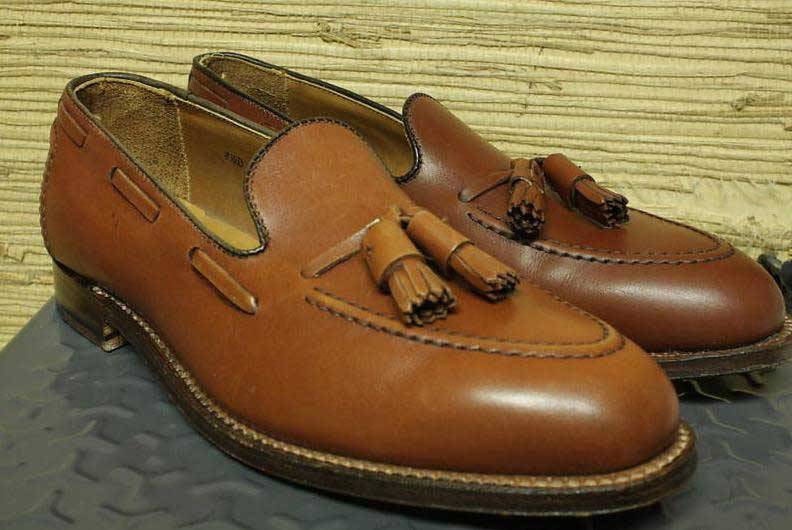
Then it occurred to me - the seller must have caked on a bunch of neutral shoe polish wax. He didn’t know how to properly shine shoes. The result is something like the picture you see above, even though the shoes were new. 
The best way to get rid of heavy wax build-up is to use Lexol leather cleaner. “Mixed” solutions such as Allen Edmonds conditioner and cleaner won’t be enough (though they’re still good for regular maintenance). If the build-up is especially bad, you might even have to run your fingernail over the stitches and around the pinking (the zig zag detailing). That’s what I found myself doing last night for about an hour.
The problem with having so much wax build-up is that it not only creates ugly creases (particularly if you use a neutral wax), but it also prevents the leather from absorbing any conditioner, which means it will eventually dry out. To avoid this, go easy on the wax, and every once in a while, use some Lexol leather cleaner to wipe away any build-up. Remember that a little wax goes a long, long way.
Or, if you prefer, just stick to cream polish. You won’t get as much protection from the elements, or perhaps even as high of a shine, but at least your shoes will never look like the ones above. 

Go Easy on the Wax

I recently bought a new pair of Crockett and Jones Belgraves from a seller I found online. I was able to get them at a nice discount, but when they arrived, they had thin white creases in certain parts of the leather. I figured the leather must have been just dry, so I treated it with some conditioner. Even after a few treatments, however, they didn’t go away. In fact, when I worn them around a bit, awful white lines would appear wherever the leather would bend. 

Then it occurred to me - the seller must have caked on a bunch of neutral shoe polish wax. He didn’t know how to properly shine shoes. The result is something like the picture you see above, even though the shoes were new. 

The best way to get rid of heavy wax build-up is to use Lexol leather cleaner. “Mixed” solutions such as Allen Edmonds conditioner and cleaner won’t be enough (though they’re still good for regular maintenance). If the build-up is especially bad, you might even have to run your fingernail over the stitches and around the pinking (the zig zag detailing). That’s what I found myself doing last night for about an hour.

The problem with having so much wax build-up is that it not only creates ugly creases (particularly if you use a neutral wax), but it also prevents the leather from absorbing any conditioner, which means it will eventually dry out. To avoid this, go easy on the wax, and every once in a while, use some Lexol leather cleaner to wipe away any build-up. Remember that a little wax goes a long, long way.

Or, if you prefer, just stick to cream polish. You won’t get as much protection from the elements, or perhaps even as high of a shine, but at least your shoes will never look like the ones above. 

For $50 You Can Buy …
LL Bean Signature discounted their suede Eastport moc toe shoes. The Ranger moc can be had for $40 and blucher moc for $35. Personally, I like the regular leather versions of each a bit more, but $35-40 is a great price for a casual pair of shoes. I think they would work particularly well with a pair of dark jeans in the fall. 

For $50 You Can Buy …

LL Bean Signature discounted their suede Eastport moc toe shoes. The Ranger moc can be had for $40 and blucher moc for $35. Personally, I like the regular leather versions of each a bit more, but $35-40 is a great price for a casual pair of shoes. I think they would work particularly well with a pair of dark jeans in the fall. 

Dealing with Bad Weather
Every year starts off with a few months of bad weather. First there is snow, then the snow turns to slush, and finally the slush gives way to showers. Depending on where you live, these conditions can put a real beating on your clothes, so it’s good to know how to best take care of them.
Salt Stains on Shoes
The best care is preventative. There are a number of treatments that can give your shoes a superficial layer of protection. Use a thin layer of wax polish on calf leather dress shoes and mink oil lotion on work or hiking boots (you can buy both at most shoe repair shops). Note that you don’t want to use mink oil on dress shoes; if you do, your shoes will never take a proper shine.
For added protection, use a pair of overshoes. Swims makes an attractive flocked version that slips on easily, while Tingley makes a very affordable (albeit less attractive) model. You can read Jesse’s review of Tingley here.
If you’ve picked up salt stains despite these measures, however, you need to treat them as soon as you get home. Mix one part vinegar to two parts water (or half and half for more serious stains). Brush off your shoes with a horsehair brush to remove any dirt, then dab a soft towel in the solution and gently use it to wipe off the stain. Once you’re done, use a clean damp towel to wipe off any vinegar residue. Leave it to dry for 30 minutes and repeat as needed. You want to work through this slowly, patiently, and gently; rubbing too hard can also damage your shoes. Once you’ve gotten the stain out, apply leather conditioner, polish, and wax again so that they’re protected next time you use them.
If the salt has raised the leather on your shoes (ie given it a welt), use a bottom end of a spoon and press down on the leather.
Drenched Shoes
If you’ve been going through a downpour, your shoes are probably soaked through. Again, the best care is preventative, so follow the steps above. You can also spray a suede protectant on suede. Suede should be fine in the rain, though I wouldn’t advise using it in the snow.
Once you get home, stuff your shoes with newspaper and lay them on their side (as the soles need to dry the most). You may want to change the paper every few hours just to make it effective. After they’re dry, stick unvarnished cedar shoe trees in them and leave them alone for two days so they can fully recover. Resist any temptation to set them near a heater. Doing so will only dry out and crack the leather.
Mold
If wet clothes or umbrellas aren’t allowed to dry properly, they’re at risk of developing mold. Once mold grows, they can develop a smell that can be very, very difficult to get out.
To prevent this, brush off your jackets or coats with a clothes brush once you get home. I use a separate brush for this from the one I regularly use to clean my clothes. Once the snow or water has been brushed off, hang your garment on a sturdy wooden hanger (ideally with wide shoulders) and leave it in an area with good air circulation.
For umbrellas, gently shake them out a bit, but be careful not to ruin the ribs. Once you’ve gotten most of the snow or water off, leave them completely open and let them dry in a place with good air circulation. Again, don’t set them near heaters, however, as you risk damaging the canopy. Most umbrellas are made with materials that are designed to dry quickly, so this shouldn’t take too long. Once it’s dry, neatly furl the umbrella and store it away.

Dealing with Bad Weather

Every year starts off with a few months of bad weather. First there is snow, then the snow turns to slush, and finally the slush gives way to showers. Depending on where you live, these conditions can put a real beating on your clothes, so it’s good to know how to best take care of them.

Salt Stains on Shoes

The best care is preventative. There are a number of treatments that can give your shoes a superficial layer of protection. Use a thin layer of wax polish on calf leather dress shoes and mink oil lotion on work or hiking boots (you can buy both at most shoe repair shops). Note that you don’t want to use mink oil on dress shoes; if you do, your shoes will never take a proper shine.

For added protection, use a pair of overshoes. Swims makes an attractive flocked version that slips on easily, while Tingley makes a very affordable (albeit less attractive) model. You can read Jesse’s review of Tingley here.

If you’ve picked up salt stains despite these measures, however, you need to treat them as soon as you get home. Mix one part vinegar to two parts water (or half and half for more serious stains). Brush off your shoes with a horsehair brush to remove any dirt, then dab a soft towel in the solution and gently use it to wipe off the stain. Once you’re done, use a clean damp towel to wipe off any vinegar residue. Leave it to dry for 30 minutes and repeat as needed. You want to work through this slowly, patiently, and gently; rubbing too hard can also damage your shoes. Once you’ve gotten the stain out, apply leather conditioner, polish, and wax again so that they’re protected next time you use them.

If the salt has raised the leather on your shoes (ie given it a welt), use a bottom end of a spoon and press down on the leather.

Drenched Shoes

If you’ve been going through a downpour, your shoes are probably soaked through. Again, the best care is preventative, so follow the steps above. You can also spray a suede protectant on suede. Suede should be fine in the rain, though I wouldn’t advise using it in the snow.

Once you get home, stuff your shoes with newspaper and lay them on their side (as the soles need to dry the most). You may want to change the paper every few hours just to make it effective. After they’re dry, stick unvarnished cedar shoe trees in them and leave them alone for two days so they can fully recover. Resist any temptation to set them near a heater. Doing so will only dry out and crack the leather.

Mold

If wet clothes or umbrellas aren’t allowed to dry properly, they’re at risk of developing mold. Once mold grows, they can develop a smell that can be very, very difficult to get out.

To prevent this, brush off your jackets or coats with a clothes brush once you get home. I use a separate brush for this from the one I regularly use to clean my clothes. Once the snow or water has been brushed off, hang your garment on a sturdy wooden hanger (ideally with wide shoulders) and leave it in an area with good air circulation.

For umbrellas, gently shake them out a bit, but be careful not to ruin the ribs. Once you’ve gotten most of the snow or water off, leave them completely open and let them dry in a place with good air circulation. Again, don’t set them near heaters, however, as you risk damaging the canopy. Most umbrellas are made with materials that are designed to dry quickly, so this shouldn’t take too long. Once it’s dry, neatly furl the umbrella and store it away.

Part II of Jesse’s interview with Raul Ojeda is now up at StyleForum. In it, Jesse talks with Raul about how custom shoes are created and how much he charges for the service. It’s a great read for those who like to know the nitty gritty of how bespoke shoes are made.
In case you missed it, you can catch up on the interview by reading part one here.

Part II of Jesse’s interview with Raul Ojeda is now up at StyleForum. In it, Jesse talks with Raul about how custom shoes are created and how much he charges for the service. It’s a great read for those who like to know the nitty gritty of how bespoke shoes are made.

In case you missed it, you can catch up on the interview by reading part one here.

Q and Answer: What Kind of Shoes are Best for Snowy Days?

David asks: Is it OK to wear leather soled shoes through the snow, or should I really get Dainite?

If you’re just concerned about your shoes, almost any kind of sole - leather or Dainite - will be fine in the snow. Just make sure you follow the sacred rule of putting in shoe trees after you take your shoes off, and giving them a day of rest in between each wearing. If you don’t let the leather naturally dry out, you’ll really shorten your shoes’ lifespan.

If you’re asking for your own safety, I would recommend Commando soles. There’s a lot of academic research on this that you can read through Google Scholar. Like in most research, however, there’s a lot of bickering about variables, measurements, and definitions. Still, researchers agree on a few things.

First, leather soles can be dangerous on wet, smooth surfaces. There is debate on whether Topy soles make a difference, but most scholars agree that rubber soles with treads or cleats will provide four to five times better traction. This means they’ll better in foul weather conditions. Second, it’s better to have more heel-to-surface contact, which means Commando soles will be better than Dainite. A Commando sole is what you see above in the left hand picture, and Dainite is what you see on the right. 

For what it’s worth, I’ve used Topy-ed leather, Dainite, and Commando soles on snowy days and haven’t killed myself, but I do find that Danite and Commando perform slightly better than simple rubber protectors. Lug soles can be a bit clunky, but as you can see in the left-hand picture above, Alden has a model with recessed treads at the forefront’s edge. This will give you a slightly cleaner look. If need to wear dressier shoes, I recommend a studded Dainite or maybe using galoshes. 

We’re running an extensive interview I did with Raul Ojeda, the shoemaker from our shoes episode, over on StyleForum. Part one of three is up today.
I’ve become great friends with Raul since I met him while working on that episode, and I’m so impressed with what he and his colleagues are up to at their new venture Don Ville. Raul and company are making fully bespoke shoes on-premises for less than half of what other bespoke makers charge, and the shoes are gorgeous.
I don’t personally know a lot of millionaires, who have a $100,000 laying around in the budget to buy shoes over the next 10 years, because that’s what shoes cost! You know, Europeans, John Lobbs are about $6,000. Our shoes, the most expensive are maybe $2,000, maybe $2,400 when we have to start a last from the very beginning. I really don’t see how you should be paying 3, 4, $5,000 for each pair of shoes. I think you probably wouldn’t even want to wear them. 
We want to offer shoes for the many of us that love and enjoy wearing shoes. That’s the inspiration for this shop. We want to have people come over, get their measurements, and have the shoe that they really want to wear that fits very well.
(Photo by Gordon de los Santos)
Full disclosure, by the way: I mention this in the piece, but when I heard Raul was opening the shop, I talked him into trading some writing on his website for a pair of shoes.

We’re running an extensive interview I did with Raul Ojeda, the shoemaker from our shoes episode, over on StyleForum. Part one of three is up today.

I’ve become great friends with Raul since I met him while working on that episode, and I’m so impressed with what he and his colleagues are up to at their new venture Don Ville. Raul and company are making fully bespoke shoes on-premises for less than half of what other bespoke makers charge, and the shoes are gorgeous.

I don’t personally know a lot of millionaires, who have a $100,000 laying around in the budget to buy shoes over the next 10 years, because that’s what shoes cost! You know, Europeans, John Lobbs are about $6,000. Our shoes, the most expensive are maybe $2,000, maybe $2,400 when we have to start a last from the very beginning. I really don’t see how you should be paying 3, 4, $5,000 for each pair of shoes. I think you probably wouldn’t even want to wear them.

We want to offer shoes for the many of us that love and enjoy wearing shoes. That’s the inspiration for this shop. We want to have people come over, get their measurements, and have the shoe that they really want to wear that fits very well.

(Photo by Gordon de los Santos)

Full disclosure, by the way: I mention this in the piece, but when I heard Raul was opening the shop, I talked him into trading some writing on his website for a pair of shoes.

House Shoes
Although it’s very much a cultural issue, I prefer having separate shoes for when I’m at home. You can change between shoes at the porch, and doing so will ensure that you don’t track in filth. Indoor shoes can also provide your feet with support and, at the same time, be more comfortable than lace ups.
There are a variety of options. On the more “formal” side, there are Prince Albert slippers, which are typically velvet and have quilted silk linings. The English aristocracy used to wear these when they received people into their homes. They were worn with tuxedos and smoking jackets, but in the past few decades, they’ve migrated to the more casual side of the spectrum. I think they look quite smart with a pair of casual trousers, button up shirt, and a sweater. Black is the most traditional color, but brown, navy, and British racing green work nicely as well. I like them plain, but if you get an emblem, I suggest that it be of something with personal relevance (e.g. your initials, a sport you play, or a school you attended). You can buy such slippers from Brooks Brothers, Stubbs & Wooton, Broadland, Bowhill & Elliot, and Shipton & Heneage. You’ll also find that most major English shoemakers have them for sale.
For more casual options, there are Grecian, mule, and moccasin-styled slippers. These typically come in leather and sometimes have sheepskin lining. I think such slippers look best with a heel cup, but the mule style will be easier to take on and off. Drapers of Glastonbury makes really excellent models, and Pediwear has them for pretty attractive prices. You can also get some handsome ones at Brooks Brothers, Morlands, Jeremy Law, and Mr. Porter.
Some American men may want even more casual options still. For those men, I’d recommend LL Bean, Lands End, and Ralph Lauren. I personally don’t find those styles to be as attractive, but they can look more suitable if you wear jeans or sweatpants at home. You can also check out Muji (both the European and American webshops). They have slippers at extremely affordable prices.
Finally, two additional pairs I think you should consider are the travel and bath slipper. If you travel a lot, a pair of travel slippers can be nice for when you’re at the hotel. They’re also wonderful for long flights since your feet swell during air travel. La Portegna makes some really handsome ones, but as I’ve written before, their shipping is a bit high. I’ve been told, however, that they’re working on expanding their US distribution. The other pair of slippers you may need are terry cotton bath slippers. These should be worn underneath a bathrobe when you’re heading off to the shower. Having a separate pair helps ensure that you don’t stick damp feet into your lounge slippers, which can be bad for both your feet and your shoes. If you buy nice slippers, you might as well make sure they last.
(pictured above: Derek Rose Gower slippers)

House Shoes

Although it’s very much a cultural issue, I prefer having separate shoes for when I’m at home. You can change between shoes at the porch, and doing so will ensure that you don’t track in filth. Indoor shoes can also provide your feet with support and, at the same time, be more comfortable than lace ups.

There are a variety of options. On the more “formal” side, there are Prince Albert slippers, which are typically velvet and have quilted silk linings. The English aristocracy used to wear these when they received people into their homes. They were worn with tuxedos and smoking jackets, but in the past few decades, they’ve migrated to the more casual side of the spectrum. I think they look quite smart with a pair of casual trousers, button up shirt, and a sweater. Black is the most traditional color, but brown, navy, and British racing green work nicely as well. I like them plain, but if you get an emblem, I suggest that it be of something with personal relevance (e.g. your initials, a sport you play, or a school you attended). You can buy such slippers from Brooks Brothers, Stubbs & Wooton, Broadland, Bowhill & Elliot, and Shipton & Heneage. You’ll also find that most major English shoemakers have them for sale.

For more casual options, there are Grecian, mule, and moccasin-styled slippers. These typically come in leather and sometimes have sheepskin lining. I think such slippers look best with a heel cup, but the mule style will be easier to take on and off. Drapers of Glastonbury makes really excellent models, and Pediwear has them for pretty attractive prices. You can also get some handsome ones at Brooks Brothers, Morlands, Jeremy Law, and Mr. Porter.

Some American men may want even more casual options still. For those men, I’d recommend LL Bean, Lands End, and Ralph Lauren. I personally don’t find those styles to be as attractive, but they can look more suitable if you wear jeans or sweatpants at home. You can also check out Muji (both the European and American webshops). They have slippers at extremely affordable prices.

Finally, two additional pairs I think you should consider are the travel and bath slipper. If you travel a lot, a pair of travel slippers can be nice for when you’re at the hotel. They’re also wonderful for long flights since your feet swell during air travel. La Portegna makes some really handsome ones, but as I’ve written before, their shipping is a bit high. I’ve been told, however, that they’re working on expanding their US distribution. The other pair of slippers you may need are terry cotton bath slippers. These should be worn underneath a bathrobe when you’re heading off to the shower. Having a separate pair helps ensure that you don’t stick damp feet into your lounge slippers, which can be bad for both your feet and your shoes. If you buy nice slippers, you might as well make sure they last.

(pictured above: Derek Rose Gower slippers)

Q and Answer: How Should You Store Your Shoe Care Supplies?
Matt writes to ask: Can you suggest a kit or supply chest for shoe care products?
Ethan Desu once wrote something that I liked very much. He said that you should enjoy the process of polishing shoes, not just the results. Ethan learnt to polish shoes with a friend who liked to sit around, drink tea, and talk all afternoon. Polishing shoes was just a good excuse to do those things. 
I find a lot of truth in that. I personally polish shoes alone, but I find the process very calming and meditative. Though you don’t need a supply chest to enjoy the process, having something nice can make it feel more special. Let’s review some options, going from the highest-end to the most affordable. 
If money were no object, you can get a shoeshine kit from Ephtée (pictured above). Ephtée is a French company that specializes in handmade, customized shoe trunks and storage sets. Their supply chests cost anywhere from $600 to $1,500, depending on the box and what you get in it. A Suitable Wardrobe also has three incredibly handsome options that cost between $285 and $800. These are all very expensive, to be sure, but they’re the nicest I’ve seen anywhere and they come as complete kits. 
A bit more affordable, though still expensive, is Orvis’ Gentleman’s shoeshine kit. It’s made by Col. Littleton, a Tennessee manufacturer of upscale leather goods. I find the finishing details on the box to be very nice. Saphir also makes a great kit. Both of these cost about $200 and I think they would make for fine gifts this Christmas.  
There are many options below $200 as well. Famaco has some leather carriers in large and small sizes. The smaller one may be especially good if you travel often. There are also a number of traditional wooden boxes that can be had for under $50. Bexley has one in a natural color, and Shoe Shine Kit, Shoe Care Supplies, and Shoe Tree Marketplace have some with various finishes and engraving options. For even more affordable buys, do a search on eBay for shoe shine box, shoe shine kit, and shoe shine stand. You can also browse Etsy for the same terms. There are literally hundreds of options on those sites, many of which cost about $25 or so. 
Finally, though it’s nice to have a fancy box specially designed for shoe supplies, don’t forget you can use almost any container. Jesse recently won this auction for a vintage sport-and-field shell carrier. It was made by Abercrombie and Fitch back when they were a fantastic, upscale sporting goods store and not disturbingly bad, teen apparel merchandiser. The carrier was originally meant to hold shotgun shells, but I think it would be perfect for shoe care supplies. If you live near good flea markets, you can probably find something just as great for not too painful of a price. 

Q and Answer: How Should You Store Your Shoe Care Supplies?

Matt writes to ask: Can you suggest a kit or supply chest for shoe care products?

Ethan Desu once wrote something that I liked very much. He said that you should enjoy the process of polishing shoes, not just the results. Ethan learnt to polish shoes with a friend who liked to sit around, drink tea, and talk all afternoon. Polishing shoes was just a good excuse to do those things. 

I find a lot of truth in that. I personally polish shoes alone, but I find the process very calming and meditative. Though you don’t need a supply chest to enjoy the process, having something nice can make it feel more special. Let’s review some options, going from the highest-end to the most affordable. 

If money were no object, you can get a shoeshine kit from Ephtée (pictured above). Ephtée is a French company that specializes in handmade, customized shoe trunks and storage sets. Their supply chests cost anywhere from $600 to $1,500, depending on the box and what you get in it. A Suitable Wardrobe also has three incredibly handsome options that cost between $285 and $800. These are all very expensive, to be sure, but they’re the nicest I’ve seen anywhere and they come as complete kits. 

A bit more affordable, though still expensive, is Orvis’ Gentleman’s shoeshine kit. It’s made by Col. Littleton, a Tennessee manufacturer of upscale leather goods. I find the finishing details on the box to be very nice. Saphir also makes a great kit. Both of these cost about $200 and I think they would make for fine gifts this Christmas.  

There are many options below $200 as well. Famaco has some leather carriers in large and small sizes. The smaller one may be especially good if you travel often. There are also a number of traditional wooden boxes that can be had for under $50. Bexley has one in a natural color, and Shoe Shine Kit, Shoe Care Supplies, and Shoe Tree Marketplace have some with various finishes and engraving options. For even more affordable buys, do a search on eBay for shoe shine box, shoe shine kit, and shoe shine stand. You can also browse Etsy for the same terms. There are literally hundreds of options on those sites, many of which cost about $25 or so. 

Finally, though it’s nice to have a fancy box specially designed for shoe supplies, don’t forget you can use almost any container. Jesse recently won this auction for a vintage sport-and-field shell carrier. It was made by Abercrombie and Fitch back when they were a fantastic, upscale sporting goods store and not disturbingly bad, teen apparel merchandiser. The carrier was originally meant to hold shotgun shells, but I think it would be perfect for shoe care supplies. If you live near good flea markets, you can probably find something just as great for not too painful of a price. 

Q and Answer: How Should You Protect Your Suede Shoes?
Brett writes to ask: I have a pair of suede plain-toe bluchers coming from Alden.  What do you do, if anything, for protection or treatment?
Some  people think suede shoes are too delicate and need  babying, but in  actuality, if you know how to take care of them, they’re easier to  maintain than regular calf. You don’t have to  condition, polish, or wax them every couple of weeks, after all. Here are some basic  maintenance tips:
Apply a waterproofing spray to protect them from stains and    water. Brush with a suede brush before and after the spray. I    use Allen Edmonds’ spray protectors and brushes.
If you get a stain, use a suede eraser. Again, I use Allen Edmonds’. 
If you get mud on them, let the mud dry overnight and brush it off    with a stiff brush (eg a nail brush). If there is some remainder dirt left,  wipe it off with a clean, damp cloth or use the suede eraser. 
In most cases, if your shoes get wet, they should be fine. In some   cases, however, they can be left with water stains. It  may sound   counter-intuitive, but in those situations, I recommend  you wash your   shoes, like this.
If your stains are more serious, such as those from oil or grease,    you may be in trouble. Try brushing it off with a stiff brush and    applying the suede eraser. If those don’t work, hand wash them. A   last ditch attempt could be to just take them to a cobbler for a   professional cleaning. If all those fail, you’ll have to either tell   yourself the stain is a “patina” or resign your shoes.  
If your suede shoes are old, hold them over a pot of  boiling water and let the steam hit it. After that, brush them with a  suede brush. This should restore the material’s nap and luminescence. 
The above  should be done in addition to all the other things you  should be doing  for your shoes: Insert unvarnished, cedar shoe trees  whenever you’re not  wearing your shoes; let them have at least a day of  rest in between  each wearing; and use shoe horns when you can. 
Don’t be afraid to wear them in more inclement weather,  either. I     personally  wouldn’t recommend wearing them at the end of winter, when     there is a  bunch of half-melted, dirty, slushy snow outside, but  almost  any   other time is  fine. I wear mine more or less year round.
In the end, remember: shoes are meant to be worn. There’s a   difference between aging well and aging poorly, but your shoes are   always going to age. If you invest in quality shoes and do the above,  they’ll age well and actually look better than they did when they were  brand new.

Q and Answer: How Should You Protect Your Suede Shoes?

Brett writes to ask: I have a pair of suede plain-toe bluchers coming from Alden.  What do you do, if anything, for protection or treatment?

Some people think suede shoes are too delicate and need babying, but in actuality, if you know how to take care of them, they’re easier to maintain than regular calf. You don’t have to condition, polish, or wax them every couple of weeks, after all. Here are some basic maintenance tips:

  • Apply a waterproofing spray to protect them from stains and water. Brush with a suede brush before and after the spray. I use Allen Edmonds’ spray protectors and brushes.
  • If you get a stain, use a suede eraser. Again, I use Allen Edmonds’.
  • If you get mud on them, let the mud dry overnight and brush it off with a stiff brush (eg a nail brush). If there is some remainder dirt left, wipe it off with a clean, damp cloth or use the suede eraser.
  • In most cases, if your shoes get wet, they should be fine. In some cases, however, they can be left with water stains. It may sound counter-intuitive, but in those situations, I recommend you wash your shoes, like this.
  • If your stains are more serious, such as those from oil or grease, you may be in trouble. Try brushing it off with a stiff brush and applying the suede eraser. If those don’t work, hand wash them. A last ditch attempt could be to just take them to a cobbler for a professional cleaning. If all those fail, you’ll have to either tell yourself the stain is a “patina” or resign your shoes. 
  • If your suede shoes are old, hold them over a pot of boiling water and let the steam hit it. After that, brush them with a suede brush. This should restore the material’s nap and luminescence.
  • The above should be done in addition to all the other things you should be doing for your shoes: Insert unvarnished, cedar shoe trees whenever you’re not wearing your shoes; let them have at least a day of rest in between each wearing; and use shoe horns when you can.
  • Don’t be afraid to wear them in more inclement weather, either. I personally wouldn’t recommend wearing them at the end of winter, when there is a bunch of half-melted, dirty, slushy snow outside, but almost any other time is fine. I wear mine more or less year round.

In the end, remember: shoes are meant to be worn. There’s a difference between aging well and aging poorly, but your shoes are always going to age. If you invest in quality shoes and do the above, they’ll age well and actually look better than they did when they were brand new.

We Got It For Free: Benjo’s Laces
When I was growing up in Southern California in the late ’80s/ early  ’90s, all the cool kids wore Adidas, and the even cooler kids wore them  with colored shoelaces. Lately, that seems to be coming back - mostly  with boots, but also with dress shoes.
Benjo’s,  one of the companies that makes such laces, sent me some to check out. I  was given a wide assortment of colors and each pair of laces was  waxed, which made them a bit stiff, but also more durable. They’re each  30” long, which means they’re most appropriate for shoes with three to  five eyelets (ballparking, as it depends on how wide your shoes are). I  put a pair of the dark green laces on my chocolate brown, suede chukkas,  and I like them.
In the next month or two, it seems like they’ll soon have some new  colors, new lengths, and some unwaxed and flat lace versions. Some will be  long enough for bigger boots such as the Alden Indys. Keep an eye on  their site.

We Got It For Free: Benjo’s Laces

When I was growing up in Southern California in the late ’80s/ early ’90s, all the cool kids wore Adidas, and the even cooler kids wore them with colored shoelaces. Lately, that seems to be coming back - mostly with boots, but also with dress shoes.

Benjo’s, one of the companies that makes such laces, sent me some to check out. I was given a wide assortment of colors and each pair of laces was waxed, which made them a bit stiff, but also more durable. They’re each 30” long, which means they’re most appropriate for shoes with three to five eyelets (ballparking, as it depends on how wide your shoes are). I put a pair of the dark green laces on my chocolate brown, suede chukkas, and I like them.

In the next month or two, it seems like they’ll soon have some new colors, new lengths, and some unwaxed and flat lace versions. Some will be long enough for bigger boots such as the Alden Indys. Keep an eye on their site.