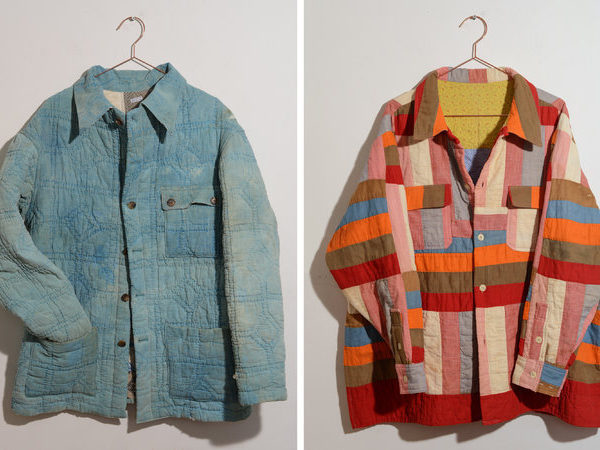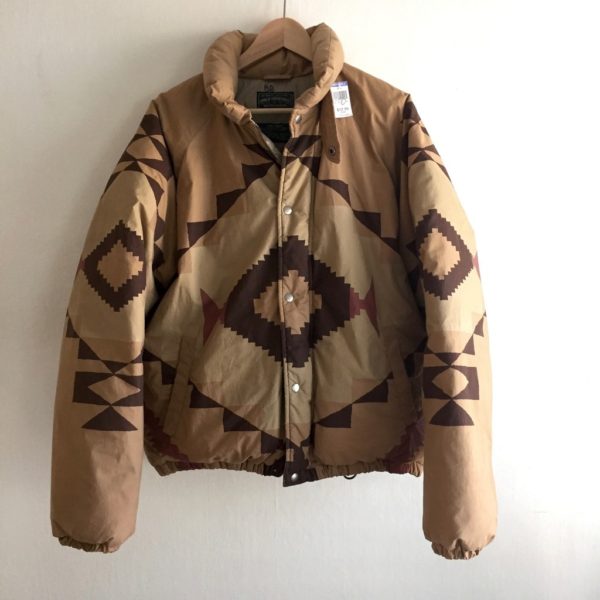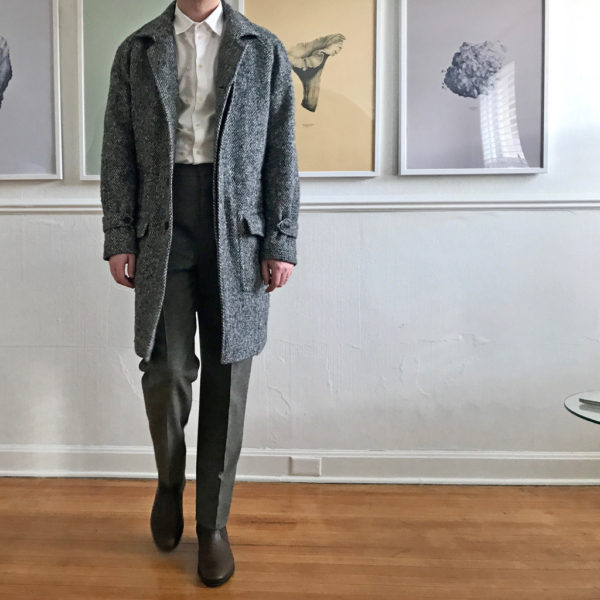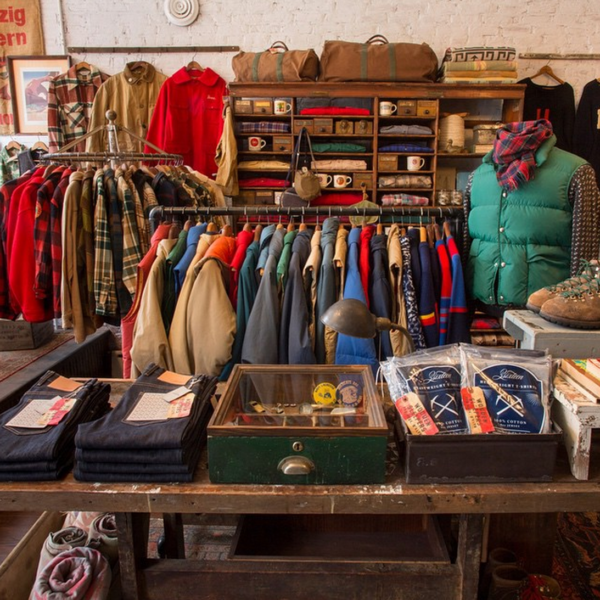
Selectism has some really nice photos of Wooden Sleepers, the Etsy-store-turned-Brooklyn-vintage-shop we mentioned last week in our post about how to thrift online. You can see the feature here.
Q and Answer: How Slim Should Pants Be?
John writes us to ask: Where do you land on the tapering and fullness of trousers? Just yesterday, I came across a really nice flannel suit at a thrift shop. The jacket fits like a glove, and the trousers just need a tiny bit of hemming … but I feel like the legs are practically stovepipes. Maybe I’m too used to wearing skinny trousers, but those big suit legs make me feel like I’m in a 1930s costume. How much can one take out of the legs, and when should you leave well enough alone for fear of ruining the balance of a suit?
There’s not an easy answer to this, as a lot depends on your body type, sense of style, and whatever is in fashion at the moment. Men wore trousers that were quite full in the ’30s and ‘40s, and then slimmed them down in the ‘50s and ‘60s, only to have them full again in the ‘70s and ‘80s. Throughout these times, however, good tailoring stood as good tailoring – and unless you’re going for much more avant garde looks – that typically means having clean lines all around, with no puckering or pulling on the front or back of your trousers.
How pants should fit, however, is very different from their silhouette, which means as long as you follow those basic principles, how you want your trousers to look is largely about taste. My personal rules of thumb are:
- Beware of going overly slim: Very slim trousers are in fashion at the moment, but they’re harder to pull off than most people think (perhaps figuratively and literally). I find they look best on men with very skinny frames or middle-of-the-road athletic builds, but not so great on everyone else. When wearing slim trousers, be honest about whether they look flattering on you.
- Add a little tapering: It’s nice to have a little tapering below the knee, just to add some shape to the legs. If you have pleats, however, be careful about narrowing them too much, lest you want to exaggerate the silhouette. Similarly, pay attention to how your feet look in proportion. Large leg openings can make your feet look unusually small, while narrow ones can make them look unusually big.
- Keep things proportional to the jacket: Perhaps most obvious, keep things in proportion to your sport coats or suit jackets. I do find, however, that unless you’re at the extremes of silhouettes, there’s a lot of wiggle room to be had here. Slim trousers can really sharpen up a traditionally cut sport coat, so don’t be afraid to slim things down if you think it might make the overall silhouette look better.
In his book Eminently Suitable, one of my favorite menswear writers, Bruce Boyer, wrote: “wearing clothes well is still something of an art – it has not descended to one of the sciences.” Other than fitting well, there’s no hard rule for how trousers should look, so it’s largely dependent on your body type and sense of style. That doesn’t make things easy, but it does make things more exciting and interesting.
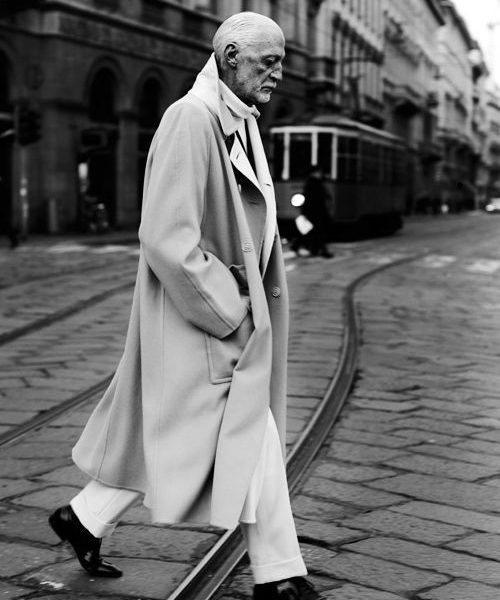
Above: some photos from The Sartorialist that, I think, illustrate how men can look good with slim, full, or middle-of-the-road cuts.
Shrinking Wool Sweaters
As much as I admire vintage clothing, I rarely shop in thrift stores, only because I assume nothing will fit my small frame. Jerrod at Oxford Cloth Button Down, however, has an inspiring post showing how you can shrink a sweater two or three sizes down. I emailed him to get details:
- First, you have to be OK with losing the sweater. This is obviously not an exact science, and he’s ruined more sweaters than he’s saved. However, with the prices in thrift stores, this is usually not such a big deal.
- If you need a sweater to shrink a lot, then throw it in the washing machine under a hot, hot water cycle. When it’s done, take it out and shape it to the size you want. It should dry to the size you need.
- If you only need the sweater to shrink a little, then spray it down with a water bottle and put it in the dryer. Check on it every three to five minutes.
The downside is that all sweaters will felt, although some more than others (in the pink Shetland above, it was pretty minimal). To minimize felting, try putting the sweater in a pillowcase or mesh laundry wash bag. This should help prevent the sweater from beating against the side of your washing machine’s drum.
You might also get away with just hot soaking your sweater, like denim enthusiasts sometimes do with unsanforized jeans. In this way, fill your bathtub or a bucket full of hot water, and submerge you sweater. Leave it in for thirty minutes or so, and keep putting in more hot water throughout the process to keep the temperature up. This should shrink the sweater without needing to agitate it (which is what causes the felting). If you only need certain parts to shrink, you can also try submerging only those areas. I’ve successfully done this with jeans.
Relatedly, you can stretch and tailor a sweater, if need be.
(Photos via Oxford Cloth Button Down)
How Should Baby Boys Dress?
Since I had a son a little more than a year ago, a surprising number of people have asked me how little boys should dress. My honest feeling is that it doesn’t matter that much how little tiny kids dress, but I’ve also been annoyed at the choices for little boys, so I thought I’d outline my thoughts on the matter briefly. (If only to have something to send people too.)
- It seems criminal to me to bring new baby clothes into the world. If you aren’t deluged by hand-me-downs from family and friends, your local thrift store is chock-a-block with lightly-worn cloths. Want something more specific? Craigslist and eBay are full of cheap stuff.
- Simple, solid-colored clothes will be a blessing when you’re trying to dress your child presentably after sleeping four hours the previous night.
- For babies, solid-colored onesies are great. White is often the only color you can buy inexpensively that doesn’t have something dumb on it, but white’s perfectly fine (and launderable as heck).
- Find a brand you really like? Search for it on eBay. We’ve loved Zutano clothes for our son, and while we’ve bought some on Amazon, mostly it’s come second-hand for two or three dollars a piece.
- Baby clothes with funny things written on them are not funny.
- In fact: baby clothes with anything written on them are pretty lame. Even your favorite indie rock band. Babies can’t read.
- Sweatpants are fine for any child who isn’t school age. They’re washable, comfortable and completely appropriate for babies.
- You really only need one or two sets of “nice clothes,” and that can mean solid-colored cotton pants and one polo shirt.
- Want a template for a little kid’s clothes? Check out a kid from Sesame Street in the 70s and 80s. No brands, no characters, no nonsense.
- Overalls are f'ing adorable.
When I’m at the thrift store, I go through the racks looking for almost anything that will fit my son within the next six months or so that also has no writing or branded characters on it. What I find, I usually buy. That’s most of his clothes, and he usually looks great.
Of course, he’s a great-looking kid. ;)
How do you know you’re officially official? Perhaps when there’s a profile of you in GQ. They followed me on a day of sartorial indulgence in LA - a fitting with a tailor, one with our friend Raul (from our shoes episode) at his new store Don Ville, and a pile of thrift stores.
My thanks to Shona Sanzgiri, who wrote the piece, and Gordon de los Santos, who shot the beautiful photos.
How to Thrift for Menswear
Part Three: Getting the Good Stuff
So: you’ve got your locations scouted and you’re repeating our thrifting philosophies in your head. What about picking the good stuff?
Thrift stores are full of high-quality menswear. Menswear is relatively timeless. Women shop for men, and they make mistakes - sometimes expensive ones. The kind of men who buy high-quality clothes don’t want to be bothered with selling them. The stuff is out there.
Here’s eight tips on how to pull in the cream of the crop:
- Know your fit. If you don’t try things on, you’re begging for a disaster. Learn what can be altered, then stick to stuff that will fit perfectly.
- Buy it when it’s there. Every thrift store piece is one in a million. Maybe more. Don’t put it back on the rack and go get lunch or even walk around the store thinking about it. If it’s right, buy it.
- Time your visits. Thrift stores keep regular schedules - new stock goes out at specific times. Either observe the patterns or simply ask politely when new stuff goes out. You can also try to hit sales, but at thrift store prices, getting something great is much more important than saving $5 or $8.
- Touch and stare. Perfect the thrift cruise. Run your hand across the shoulders of the garments while inspecting as carefully as you can. You’ll feel the good stuff as much as you’ll see it.
- Look for damage. Look carefully for damage. CAREFULLY. There’s nothing worse than losing $25 on a jacket with moth holes you missed, or a big stain. Hold pieces up to natural light to help spot holes, and check for stains - pants lining could be yellow (eww) or collars could be soiled. If you’re willing to put in the time and resources, you can fix these things (I’ve had pants linings replaced before), but factor that into your cost.
- Know your brands. Your goal should be to identify quality by sight and touch, but you can also cheat with a brand list. Of course, even pieces by fine brands can be sub-par, damaged or out-of-date, but it’s a start.
- Watch out for licensees & diffusion lines. If you find a piece by a well-known brand, but it’s not great quality, it’s probably a licensee or a diffusion line. Just as Ralph Lauren makes everything from Purple Label to J.C. Penney’s American Living, many brands offer goods at a variety of quality levels. Many fashion houses also sell or have sold their names to low-quality makers in their non-core businesses (like menswear). You can read our fuller piece about menswear licenses and thrifting, but suffice it to say: if the label says Yves Saint Laurent, Pierre Cardin, Givenchy, Lanvin or Christian Dior, it’s probably a piece of crap.
- eBay is your friend. If you’ve got a smart phone, you’ve got a way to identify the value of that piece in your hand. Search for completed auctions on the web or in the eBay app and get a sense of the market. Some brands fly under the eBay radar, but for larger brands, it’s an easy way to distinguish between Brioni (primo) and Baroni (junk).
One of the great pleasures of thrift store shopping is the opportunity to put your hands on all kinds of clothes - from the best to the worst. There are innumerable signs of quality, but here are a seven basic guidelines.
- Look for trousers with details that mean quality. Split waistbands, pick stitching in the fly, a belt loop, suspender buttons and a closure with a generous tab are good signs of a quality piece.
- Look for shirts with mother-of-pearl buttons. They’ll look more lustrous and feel cold on your lip. They’re more expensive and prone to chipping, so they’re only used on high-quality shirts.
- Look for fully canvassed jackets. Better jackets will have three discrete layers in their chest - an outer, a lining and a canvas in between. Use the pinch test to distinguish. If you only feel two, they canvas and outer are glued together, a sign of a lower-quality jacket.
- Don’t by corrected-grain shoes. Shoes that have a shiny, plasticky look are made of “corrected” or “polished” leather. Because of imperfections, they top layer is sanded off, then replaced with a plastic coating. This is cheaper than picking undamaged hides, so it’s most of what you’ll find on the thrift store shelf. They’re not worth your time or your $10.
- Never buy synthetics. I’ve been trying to think of a good reason to buy a piece of clothing with any synthetic fiber in it at all. All I can think of is a trench coat, which might have some synthetic for warding off rain. Otherwise, if you see polyester or nylon, put it back on the shelf.
- Don’t buy third-world-made goods. With the exception of basics that you need at that moment (say a perfectly fitting Brooks Brothers oxford - the classic thrift shirt), there’s no reason to buy clothes made in the third world. The words “Made in England” (or Italy or the US or Canada or Switzerland or Germany) don’t guarantee quality goods, but the words “Made in Bangalore” generally do guarantee something that’s mall-quality at best.
Of course, you’ll gain knowledge with experience, and you’ll make mistakes along the way, but I think you’re ready to get out there and shop!
Read the two other articles in our series: Thrifting Philosophy & Finding the Best Thrift Stores.
How to Thrift for Menswear
Part Two: How to Find the Best Thrift Stores
Thrifting is an immensely rewarding hobby, and a great way to find great clothes on a budget, but it only works when you’re visiting the right stores. Yesterday we covered the basic philosophy of thrifting. The second part of our three-part series on thrift store shopping for menswear is all about finding those stores. Here are eight tips to help you find the best thrift stores.
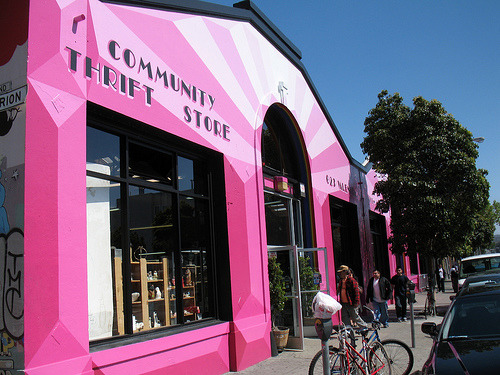
- Good neighborhoods mean good thrift stores. Generally speaking, the more affluent and deep-rooted the neighborhood, the better the stock. Your best bet are older, richer neighborhoods with long-standing residents. There are good thrift stores in lousy neighborhoods and lousy stores in good ones, but you want to go to where people who can afford to donate good stuff will go to do their donating.
- Ritzy charities have ritzy thrift stores. Most thrift stores are non-profits that benefit charities. Look for stores that benefit local charities with a moneyed donor base. Local institutions like the opera or symphony are good bets, as are private schools or civic organizations. Richer people give better stuff, and if people are donating because they care about the organization, they give more freely.
- Avoid the cool kids. Any area with a large student population or a lot of young creatives will have less stock in stores. In short, they’ll be picked-clean.
- Look for stores that rotate their stock. When you visit a store a few times, notice how much their stock rotates. More fresh stuff means more chances to find something great.
- Avoid for-profits. Many parts of the country have been infected with for-profit thrift chains like Savers. The quality of merchandise is lower (people are giving simply because their stuff has no value to them, not to benefit a charity), the prices are higher and you won’t get the satisfaction of helping a non-profit.
- Ask about stock distribution. Some chain thrifts put out stock solely from in-store donations. Some have centralized distribution of stock. Ask a clerk where the stock comes from - you’ll know how much to consider the neighborhood.
- Look for clusters. Thrift stores tend to cluster on high-traffic, low-rent streets. Look for these clusters and use them to your advantage when shopping. I’ve got a couple of “routes,” and they’re all based on these clusters of shops.
- Follow your instincts, but check them, too. Usually bigger stores have better stuff (it’s a numbers game), and usually nicer stores do, too. Don’t just trust your first impression, though. Look through the merchandise on a couple of different days. Even if you don’t find something perfect for you, you should be able to get a general sense of quality.
- Ask a friend. Strangers on the internet won’t share their secret thrift store hot spots with you, but a friend will. Share information with your thrifting buddies, and if they give you a great tip, grab them something nice while you’re out.
- Use the internet & make a map. A search with Google Maps or The Thrift Shopper will turn up thrifts wherever you are. I use Live Maps to make a map of all the thrifts in the region, and leave it in my car for when I’m out & about.
Read the two other articles in our series: Thrifting Philosophy & Getting the Good Stuff
How to Thrift for Menswear
Part One: Thrifting Philosophies
Thrifting has been a lifelong habit for me. When I was a kid, my mom worked in a lamp store on Fillmore Street in San Francisco. Fillmore is San Francisco’s thrifting mecca, home of thrifts run by the Opera, Symphony, and a couple of fancy private schools, plus a sizable Goodwill. What clothes my mom didn’t make for me likely came from those thrift shops.
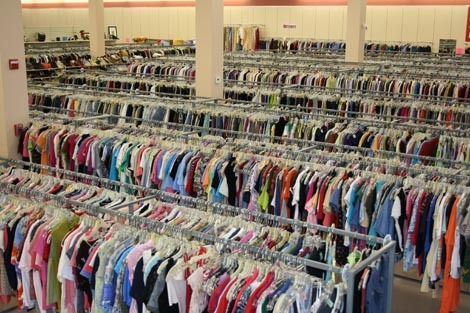
Today, I shop in thrifts all the time. It’s not just the source of much of my wardrobe, it’s also something I do almost meditatively. A thrift store is a place where you can imagine the lives of a thousand objects - and if any one of them appeals, you can almost certainly afford to bring it home.
We’ve got a three part series on how to thrift successfully coming up here on Put This On, and this is part one: the philosophy of thrifting. Later this week, I’ll share how to find great thrift stores, and how to identify what to buy. Today, eleven tips to successful thrift store shopping.
- Price is not an object. If you buy in the thrift store based on price, you’re sunk. You’ll miss the good stuff you should have bought, and you’ll buy crap you should have left behind. Our brains are naturally comparative - they look for patterns and deviations. In a thrift store, that means we think something that’s $20 is expensive, and something that’s $1 is a bargain. Fight the urge. Few are the items that are worth adding to your wardrobe at $1 that aren’t worth adding to your wardrobe at $20, and just because something’s $1 doesn’t make it a bargain.
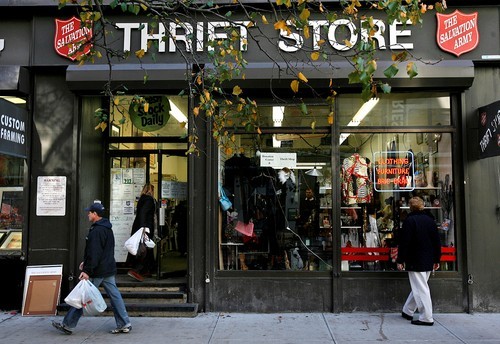
- Be nice. Thrift store employees are human beings with a tough job who appreciate your kindness. I often think of the lady at the Salvation Army on Valencia Street in San Francisco where I grew up. She was in charge of the records, and she’d always tip me off when there were new ones going out. I scored a huge collection of early 70s soul 45s that way. It pays to be nice.
- Know what you need & buy what you find. If you read my article on shopping like my mom, you know you should always have an awareness of what your wardrobe needs and will need. Let this guide your search. That said: never pass up a great piece. The time to buy something is when it’s for sale.
- Dress for success. The best thrifting outfit is comfortable and simple. It should allow you to try on clothes without much hassle. You should look presentable, too, just in case you have to ask for a price.
- Don’t cheat. Only assholes switch tags, shoplift or otherwise cheat thrift stores. These are charities for goodness’ sake.
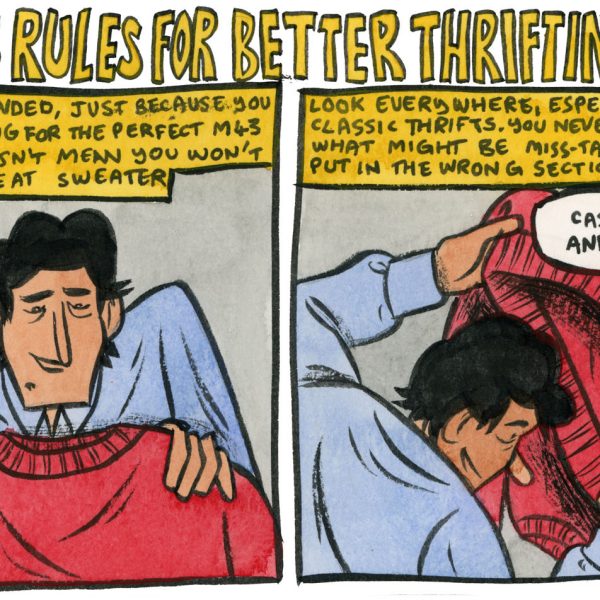
- Shop the whole store. Often the best items are miscategorized. Check out the women’s and boys’ sections so you don’t miss a great score. Remember, too, that there are plenty of non-clothing scores available in thrifts, so expand your knowledge in all areas, and bring it to bear on furniture, records, books - whatever.
- Buy for others. If you’ve got family members, friends or thrifting compatriots who appreciate nice clothes, don’t be afraid to buy for them. Know their size and be choosy, and make sure they know you don’t mind if they hate what you bought. It’s only five or ten bucks.
- Give back. If you buy from thrifts, remember to donate to thrifts. They make their money from your quality donations.
- Go regularly. Thrifting isn’t like going to Macy’s. Stock is hugely variable and constantly rotating. Only through regular visits will you get to know quality clothing and find the good stuff.
- Buy nothing. Remember that 85% of thrift store visits will lead to no purchases. That’s part of the process - don’t sweat it.
- Don’t buy it if you don’t love it. If there’s something wrong with it that makes it an “almost” and not a “heck yeah,” then skip it. Something else will come along.
Be sure to read the other two articles in our series: Finding the Best Thrift Stores & Finding the Good Stuff.
Q and Answer: How Much Can My Clothes Be Altered?
Mario writes us to ask: When you’re hunting for used quality clothing, you’re bound to come across pieces that are a couple of sizes too small or a few too big. Some of this, I assume, can be corrected with a visit to a tailor. If that’s the case, my question is: in your experience, what size range can be (relatively) easily retrofitted to your measurements?
It happens to all of us - we put our hand on a perfect garment in a thrift store. We pull it out, and it looks tremendous. We try it on, and it doesn’t quite fit. Immediately, we wonder: can it be altered?
Altering second-hand clothes is the same as altering new clothes. Some procedures are possible, some impossible. Some are easy, some difficult. Let’s take it by garment.
Shirts
- Shirt sleeves can be easily shortened, but usually they can’t be easily lengthened.
- Cuffs and collars can be replaced, but only with white (and it may be a bit expensive).
- The torso of a shirt can be brought in, and the sleeves slimmed, as in episode six of Put This On. Remove more than three or four inches and you may have a badly unbalanced shirt, depending on your shape.
- The collar button can be moved about a quarter inch either direction to make the collar larger or smaller, but this may throw off the balance of the collar. Your taste should guide you.
- The shoulders and chest of a shirt are largely inalterable.
Trousers
- The waist of a pair of trousers can be let in or taken out 2-3". Look inside the seat for extra fabric at the waistband - this, minus half an inch or so, is as far as you can take the pants out.
- Trousers are easily shortened, but lengthening them requires fabric at the hems. You should be able to turn the leg inside out to check how much room you have. Cuffs can also be removed for extra length.
- Be careful when lengthening as edge wear could leave an undesirable line when the pant is let out.
- Pleats can be removed, but you may not be happy with the result. Either they are replaced with darts, or the pants are substantially re-cut.
- Trousers can be slimmed or tapered from the bottom of the pockets down, from either the inside seam, outside seam or both.
Jackets
- Jacket waists and torsos can usually be altered by about 2", though 1" is generally safer.
- The top block of jackets - from the armholes up - is very difficult to alter. Don’t try.
- Shoulders must fit, if they don’t, put it back.
- Jacket sleeves can be taken up or down as long as the buttons are non-functional. To see how far they can be taken down, feel with your fingers inside the lining of the sleeve end for folded-back fabric. Usually there’s an inch or two, but remember that you will need to retain about half an inch to reach the lining on the inside.
- If jacket buttons are functional, the sleeve can be taken up from the shoulder, but this is a tricky and expensive process - budget $75 or so, and find a good tailor. It’s possible the sleeves can be taken down a bit, too, but you’d have to ask a tailor to look for extra fabric in the armhole.
- When lengthening sleeves from the cuff, you may find that there’s a line of wear, especially on textural fabrics like flannel.
- Vents cannot be added to or removed from jackets.
- Jacket lengths are alterable, but it’s inadvisable and expensive to try.
- Jacket lapels - same deal.
Shoes
- Shoes that are slightly too large (½ size or less) can sometimes be fit with insoles or tongue pads. This is particularly true if width is the problem, rather than length - just be careful that the ball of your foot hits in the appropriate flex point in the shoe.
- Shoes can be stretched, but only in width, not in length. Stretching can usually take a shoe about one width larger - say from D to E. Sometimes two, depends on the shoe.
Socks
- Socks are generally inalterable, but if you have notably large feet and are set on second-hand hosiery, try gluing two or more pairs of socks together, then putting both on your foot. I’ve never done it, but it seems like it might work.